The Seed of Blessing 祝福的种子
⚠ Before You Read Further⚠ 阅读前须知
Black seed thins the blood and modulates the immune system. If you take anticoagulant or antiplatelet medication (warfarin, aspirin, clopidogrel), are pregnant, are scheduled for surgery within two weeks, or are on immunosuppressant therapy, speak to your doctor before using concentrated seed, oil, or capsules. Culinary, spice-level use in food is a different matter entirely and is considered safe for the general population — the caution below applies specifically to therapeutic doses. Full detail in the Caution section further down this page.
黑种草具有一定的抗凝血作用,并会调节免疫系统。若你正在服用抗凝血或抗血小板药物(如华法林、阿司匹林、氯吡格雷),处于孕期,两周内将接受手术,或正在使用免疫抑制剂治疗,请在使用浓缩种子、油或胶囊之前咨询医生。作为食物调味品的日常少量使用则完全是另一回事,一般人群可安全食用——以下的注意事项主要针对治疗剂量。详细内容请见本页后段的”注意事项”部分。
Hold a black seed between your fingertips. It weighs almost nothing — a few milligrams of dark, ridged matter that could be lost in the crease of your palm. Yet this unassuming seed carries one of the most extraordinary endorsements in human history: a prophetic declaration made over 1,400 years ago that modern science is only now beginning to fully substantiate. It was sealed in a Pharaoh’s tomb for the afterlife. It was prescribed by history’s greatest physician. It travelled the Silk Road, the spice routes of the Ottoman kitchen, the Ayurvedic pharmacies of India, the herbal shelves of Chinese medicine, and the cooking pots of West Africa — and today it is the subject of over 130 registered clinical trials and a growing shelf of meta-analyses. This is not a folk remedy waiting to be debunked. This is a civilisational consensus, arrived at independently by cultures that never spoke to each other, now being tested one randomised controlled trial at a time. 把一粒黑种草放在指尖。它几乎没有重量——只是几毫克带着棱纹的深色物质,小到可能消失在你的掌纹里。然而这粒不起眼的种子,却承载着人类历史上最不寻常的背书之一:一则一千四百多年前的先知宣告,如今现代科学才刚刚开始将其证实。它曾被密封在法老的陵墓中,供来世之用;曾被历史上最伟大的医师开具处方;它沿着丝绸之路、奥斯曼厨房的香料路线、印度阿育吠陀药房、中医药架,一路走到西非的锅灶之中——而今天,它是130多项注册临床试验与不断增加的荟萃分析的研究对象。这不是一个等待被拆穿的民间偏方,而是一个由从未彼此交流的文明各自独立得出的共识,如今正被一项又一项随机对照试验逐步验证。
About This Article关于本文
This is a deliberately long, deep-edition article, and it’s worth being upfront about why, and how it’s put together, before you read further.
Purpose. Black seed carries one of the most quoted — and most misused — health claims on the internet: a prophetic hadith saying it heals “every disease except death.” This article exists to give that claim, and the science around it, the full and honest treatment it deserves: not a marketing slogan, and not a dismissal either. It follows this site’s Wrong Default approach — every claim is checked from both directions, the overclaim and the dismissive skepticism, before you’re told what’s actually established.
How it’s built. Three kinds of source appear in this article, and they are never blended into one voice: Qur’an (the literal word of Allah), hadith (the Prophet ﷺ’s recorded words, each with its exact collection and number — Sahih al-Bukhari, Sahih Muslim, Jami’ at-Tirmidhi, Sunan Ibn Majah), and scholars’ explanations (named commentators’ own reasoning about those texts, clearly labelled as their opinion, not scripture). Alongside that sits the modern evidence base — over 130 registered clinical trials, the 2025 meta-analysis of 82 RCTs, and specific named studies — cited the same way: claim, then source. Where the news and market record includes fraud, regulatory warnings, or overclaiming, that’s in here too, not sanded off.
What’s in it. The table of contents below maps the full structure. In short: what the hadith actually says and how classical scholars read it; a civilisational history spanning 3,300 years and thirteen cultures; the current clinical evidence, organised by condition; the chemistry behind it; a myth-busting section that cuts both ways; real news reports — the good and the uncomfortable; how to actually use it day to day, with real recipes; a reference dosage table by life stage; a proposed self-observation protocol if you want to test it on yourself; and the honest limitations and cautions, stated plainly.
You don’t need to read it in one sitting, or in order. Use the contents below to jump to what you need.
目的。黑种草背负着互联网上被引用最多、也最常被误用的健康主张之一:一则先知圣训宣称它能治愈”一切疾病,唯独死亡除外”。本文的目的,是给予这一主张及其背后的科学,一次完整而诚实的对待——既不是营销口号,也不是一笔带过的否定。它遵循本站一贯的「错误的默认值」(Wrong Default)方法:每一项主张都会从两个方向加以检验——过度宣称与轻率怀疑——然后才告诉你真正已被确立的结论是什么。
结构方式。本文中出现三类不同的资料来源,且绝不混为一谈:古兰经(真主的言辞原文)、圣训(先知 ﷺ 的言行记录,每一处均附确切的圣训集与编号——《布哈里圣训实录》《穆斯林圣训实录》《提尔米济圣训集》《伊本·马哲圣训集》),以及学者解说(具名注释家对这些经文的个人论述,明确标注为其个人观点,而非经典本身)。与此并列的,是现代证据基础——130多项注册临床试验、2025年针对82项RCT的荟萃分析,以及具体点名的研究——引用方式同样是:先陈述主张,再标明出处。凡涉及造假、监管警告或过度宣称的新闻与市场记录,本文同样如实收录,绝不粉饰。
本文包含内容。下方目录列出了完整结构。简要而言:这则圣训究竟说了什么、古典学者如何解读它;一段横跨3,300年、十三种文化的文明史;按病症整理的现有临床证据;其背后的化学机制;一个从两个方向审视迷思的破除迷思环节;真实的新闻报道——包括令人欣慰与令人不安的部分;如何在日常生活中真正使用它,附带真实食谱;一份按人生阶段划分的参考用量表;一份供你自行测试的自我观察方案建议;以及坦诚陈述的诚实局限性与注意事项。
你不必一次读完,也不必按顺序阅读。可使用下方目录直接跳转到你需要的部分。
Contents目录
- Understanding the Hadith — Qur’an, hadith, and scholars, clearly labelled理解这则圣训——古兰经、圣训与学者解说,清楚标注
- A Record Spanning Every Civilisation It Touched一段跨越所有接触过它的文明的记录
- What Modern Science Has Found现代科学的发现
- More Than One Molecule — the chemistry不止一种分子——化学机制
- The Wrong Default, Applied — myth-busting应用「错误的默认值」——破除迷思
- In the News — reports, good and uncomfortable新闻实录——好消息与不安的一面
- Bringing It Into Daily Life — recipes融入日常生活——食谱
- How Much, For Whom — dosage by life stage用量几何,因人而异——按人生阶段的用量
- Proposing a Protocol — self-observation提出一个方案——自我观察
- Petua Corner — practical tipsPetua 角落——实用小贴士
- Honest Limitations诚实的局限性
- Caution注意事项
- Why Has It Taken This Long?为什么等了这么久?
- References & Sources参考文献与资料来源
In Plain English用大白话讲
Nigella sativa is a small flowering plant. Its seeds — black, ridged, and about the size of a sesame seed — are used both as a spice and as a medicine across the Middle East, North Africa, and South and Southeast Asia. In Arabic it’s called Habbatul Barakah (tap to reveal) — “the seed of blessing.” The seed’s power comes from over 100 natural compounds working together, the most studied of which is called thymoquinone (tap to reveal). It is not a cure for any single disease. It is a broad-spectrum botanical whose effects show up modestly across many different body systems at once — which is exactly the pattern you’d expect from a food that’s been part of the human diet for over three thousand years.
黑种草(Nigella sativa)是一种开花小植物。它的种子——黑色、带棱纹、大小近似芝麻——在中东、北非以及南亚和东南亚地区,既作调味香料,也作药用。阿拉伯语称其为Habbatul Barakah(点击查看)——”祝福的种子”。这粒种子的力量来自100多种天然成分的协同作用,其中被研究最多的是百里醌(thymoquinone)(点击查看)。它并非针对某一种疾病的特效药,而是一种广谱植物——它的效果会同时、温和地体现在身体的多个系统中。这正是一种在人类饮食中存在了三千多年的食物应有的作用模式。
Understanding the Hadith理解这则圣训
Every source labelled. Qur’an, hadith, and scholars’ explanations are three different things — never blended into one voice每一处引文均标明出处。古兰经、圣训、学者解说是三种不同的东西——绝不混为一谈
A note on method: this section uses three labels throughout — QUR’AN (the literal word of Allah), HADITH (the Prophet ﷺ’s recorded words, with the exact collection and number), and SCHOLAR’S EXPLANATION (a later scholar’s own reasoning about the hadith — never the hadith itself). If a sentence isn’t inside a labelled quote box, it is this article’s own explanation, not scripture and not a scholar being quoted verbatim.
方法说明:本节始终使用三种标签——古兰经(真主的言辞原文)、圣训(先知 ﷺ 的言行记录,附带确切的圣训集与编号)、学者解说(后世学者对这则圣训的个人论述——绝非圣训本身)。凡不在标注框内的句子,均为本文自身的说明文字,既非经典原文,也非学者的逐字引述。
سَمِعْتُ رَسُولَ اللَّهِ صلى الله عليه وسلم يَقُولُ ” إِنَّ فِي الْحَبَّةِ السَّوْدَاءِ شِفَاءً مِنْ كُلِّ دَاءٍ إِلاَّ السَّامَ ”
“I heard Allah’s Messenger ﷺ saying: ‘There is healing in black cumin for every disease except as-sam.'”
「我听真主的使者 ﷺ 说:”黑种草中蕴含着治愈一切疾病的疗效,唯独As-Sam(死亡)除外。”」
Khalid ibn Sa’d narrated that Ghalib ibn Abjar fell sick on a journey. Ibn Abi ‘Atiq visited him and said: “Treat him with this black seed… for Aisha narrated to me that she heard the Prophet ﷺ saying: ‘This black cumin is healing for every disease except as-sam.'” Aisha said: “What is as-sam?” He ﷺ said: “Death.”
哈立德·本·萨阿德传述:加立布·本·艾卜贾尔在途中患病。伊本·艾比·阿提格前来探望,说道:”用这黑种草来医治他……因为阿伊莎曾对我传述,她听闻先知 ﷺ 说:’这黑种草是一切疾病的疗愈,唯独As-Sam除外。'”阿伊莎问:”什么是As-Sam?”先知 ﷺ 说:”死亡。”
Note the chain: this version reaches us through Khalid ibn Sa’d, who reports what Ibn Abi ‘Atiq said, which itself quotes Aisha’s report of the Prophet’s ﷺ words — including her own question about what “as-sam” meant. Both this hadith and 5688 are graded sahih (authentic) by Imam al-Bukhari; their authenticity is not in dispute among hadith scholars.
请留意其传述链:这一版本经由哈立德·本·萨阿德传至我们,他转述的是伊本·艾比·阿提格所说的话,而这段话本身又引述了阿伊莎对先知 ﷺ 言辞的传述——其中包括她本人对”as-sam”含义的追问。这则圣训与第5688条一样,均被伊玛目布哈里判定为「圣训」(صحيح,真实可信),其真实性在圣训学者之间并无争议。
The same core report — healing in black seed for every disease except death — is preserved across multiple independent collections beyond al-Bukhari, each with its own chain of narration. This multi-collection preservation (what hadith scholars call being “mutawatir-adjacent” in strength, though not literally mutawatir) is part of why its authenticity is considered firmly established rather than resting on a single narrator or book.
这同一核心内容——黑种草能治愈一切疾病,唯独死亡除外——不仅见于《布哈里圣训实录》,还被多部彼此独立的圣训集所保存,各自拥有独立的传述链。这种跨多部典籍的保存方式(圣训学者称之为传述力”接近广传”,尽管严格意义上并非”穆塔瓦提尔”/广传圣训),也是其真实性被认为坚实可靠、而非仅依赖单一传述者或单一典籍的原因之一。
Every one of the hadiths above is graded authentic. That is not the question any classical scholar raises. The question every one of them raises — explicitly, in writing — is what the word “kullu” (every / all) means within it. That is a question about Arabic usage and scope, asked about an accepted, authentic text — not a question about whether the text is true.
以上每一则圣训都被判定为真实可信(صحيح)。这从来不是任何一位古典学者所质疑的问题。他们每一位都明确地、以文字形式提出的问题,是其中”kullu“(每一/一切)这个词究竟是什么意思。这是一个关于阿拉伯语用法与语义范围的问题,针对的是一段已被公认真实可信的经文本身——而不是质疑这段经文是否真实。
The Interpretive Key: ‘Āmm Makhsus — General Wording, Specific Meaning解经关键:’Āmm Makhsus——措辞概括,含义具体
Every major commentator named below reads “kullu” through a tool used throughout Qur’anic tafsir generally, not invented for this hadith: in Arabic, a word with general grammatical form (“every,” “all”) frequently points to a specific, contextual meaning. Classical tafsir applies the identical reading to the Qur’an’s own wording:
“…for there was after them a king who seized every [good] ship by force.”
Read by the mufassirun (Qur’an commentators, e.g. al-Wahidi’s al-Tafsir al-Basit) as every seaworthy, valuable ship — not literally every vessel on the water.
「……因为在他们前面有一个国王,强行夺取每一艘(完好的)船只。」
经注家(如艾勒瓦希迪《al-Tafsir al-Basit》)理解为夺取每一艘适航、有价值的船,而非字面上水面上的每一艘船。
“Indeed, I found [there] a woman ruling them, and she has been given of all things, and she has a great throne.”
Read as all things relevant to a throne and kingdom — not literally every object in existence.
「我确已发现一个妇人在统治他们,她获赐一切,且拥有一个宏伟的宝座。」
理解为与王位和国家相关的一切,而非宇宙中的每一件物品。
“Destroying everything by command of its Lord.”
Describing a punishing wind — which did not destroy the sky above it or the ground it blew across. Cited by Ibn al-Qayyim (see below) as the direct rhetorical parallel to the black seed hadith’s wording.
「奉其主的命令毁灭一切。」
描述的是一场惩罚性的狂风——它并未摧毁其上方的天空,也未摧毁它掠过的大地。伊本·凯伊姆(见下文)引用此节,作为与黑种草圣训措辞在修辞上的直接对照。
When Ibn Hajar reads “shifa’ min kulli da'” (healing from every disease) in the black seed hadith the same way these verses are read, he is applying a rule of Arabic already active in interpreting Allah’s own speech in the Qur’an — not inventing a workaround for a hadith he found difficult.
当伊本·哈贾尔以同样的方式理解黑种草圣训中”shifa’ min kulli da'”(治愈一切疾病)这句话时,他所运用的,正是用于诠释古兰经中真主自身言辞时早已适用的阿拉伯语规则——而不是为了替一段他觉得棘手的圣训另寻托词。
Everything below this line is a named scholar’s own explanation (sharh / tafsir) — his personal understanding of the hadith above. None of it is Qur’an. None of it is hadith. Each is clearly attributed by name and source.
以下内容均为具名学者本人的解说(疏解/经注)——是他们对上述圣训的个人理解,既非古兰经原文,也非圣训本身。每一处均清楚标明学者姓名与出处。
No Single Plant Carries Every Benefit没有任何一种植物蕴含一切功效
His own words, as preserved by Ibn Hajar: the phrase is general in form but specific in meaning, “because there is no single plant created by Allah that carries every kind of medicinal benefit.” This is al-Khattabi’s reasoning about the hadith — the anchor line nearly every later scholar builds on.
这是他本人的说法,由伊本·哈贾尔保存下来:这句话在措辞上是概括性的,但含义是具体的,”因为真主所创造的世间,没有任何一种植物蕴含所有种类的医疗功效。”这是艾勒哈塔比针对这则圣训所作的论述——是后世几乎所有学者论述的立足点。
Real, Specific Mechanisms真实、具体的作用机制
In Fath al-Bari — the single most authoritative Sunni commentary on Sahih al-Bukhari — Ibn Hajar records concrete applications from the medicine of his era: crushed seed in cloth, inhaled, for cold-related congestion; seed cooked with vinegar as a mouth rinse for toothache. This is his own explanation of how shifa’ (healing) operates through specific applications — it is not part of the hadith text itself.
在《Fath al-Bari》——逊尼派对《布哈里圣训实录》最具权威性的注释——中,伊本·哈贾尔记录了其所处时代医学中的具体应用方法:将种子压碎、包入布中,供感冒引起的鼻塞者吸嗅;种子与醋同煮,用作漱口水以缓解牙痛。这是他本人对”shifa'”(疗愈)如何通过具体应用方式发生所作的解说——并非圣训原文的一部分。
Mechanism Diversity, Not a Blanket Cure机制多样,而非万能疗法
Working within the Galenic/Unani medical framework of his era, Ibn al-Qayyim’s own view classifies black seed as hot and dry, most naturally suited to “cold”-natured illnesses, reaching “hot” conditions through the like-treats-like logic used elsewhere in that tradition (his own example: sulphur, itself “hot,” treating hot-natured skin conditions such as ringworm). He explicitly compares the hadith’s wording to Qur’an 46:25 above — his own reasoning, offered to explain the hadith, not a claim that this reasoning is itself revealed text.
伊本·凯伊姆运用其所处时代的盖伦/尤纳尼医学体系,提出了他本人的观点:黑种草属”热性、燥性”,最适宜治疗”寒性”疾病;至于它如何触及”热性”病症,他运用的是该医学传统中”以性治性”的同类逻辑(他自己举的例子是硫磺,本身属”热性”,却被用来治疗癣等热性皮肤病)。他明确将这则圣训的措辞与上文所引的古兰经46:25节相比较——这是他本人为解释这则圣训而提出的论证,并非声称这一论证本身即为启示经文。
The Method Must Match the Illness用法必须对症
These two hold the most literal-leaning position among the named scholars — retaining the general meaning of the hadith — but even they immediately qualify it, in their own words as preserved by Ibn Hajar: treatment using black seed differs according to the specific illness. This is the direct source of Ibn Hajar’s later summary that it may be used “alone, in combination, pulverised, whole, mixed with food, or as a topical dressing” — Ibn Hajar’s own paraphrase of their position, not a hadith.
这两位学者在具名学者中持相对最贴近字面的立场——保留了这则圣训的概括性含义——但即便如此,据伊本·哈贾尔保存下来的他们自己的说法,他们也立刻加以限定:使用黑种草的方法应因病而异。伊本·哈贾尔后来那句总结——它可以”单独使用,也可以与其他食物混合、磨碎、整粒,或作为外敷之用”——正是伊本·哈贾尔对二人观点的转述与概括,并非圣训本身。
The Same Reading, Independently Reached殊途同归,独立得出同样的理解
In his commentary on Sahih Muslim, an-Nawawi holds the same ‘āmm makhsus reading as Ibn Hajar and Ibn al-Qayyim: the benefit is real and wide, conditioned by the nature of the illness, the person’s constitution, dose, preparation, and what it is combined with. Contemporary scholars (e.g. Shaykh Faraz Rabbani, SeekersGuidance, 2026) group these three names together precisely because they converge on this reading independently, from two different Sahih collections.
在其对《穆斯林圣训实录》的注释中,纳瓦维持有与伊本·哈贾尔、伊本·凯伊姆相同的’āmm makhsus解读:其功效真实且广泛,但会受到疾病性质、个人体质、剂量、制备方式,以及与何物同服等因素的制约。当代学者(如法拉兹·拉巴尼教长,SeekersGuidance,2026年)之所以将这三位并列而论,正是因为他们各自独立地、从两部不同的《圣训实录》出发,得出了趋同的理解。
Two Categories of Prophetic Statement先知话语的两个范畴
Scholars draw a real, textually-grounded distinction between two categories of prophetic statement. This is the scholars’ framework for organising the sources below — not itself a hadith or a verse.
1. Tashri’ — religious legislation and matters of the unseen.
“Nor does he speak from [his own] inclination. It is not but a revelation revealed.”
「他不凭私欲而言,那只是他所奉的启示。」
Statements in this category are unquestionably from wahy (divine revelation); no scholar treats them as open to empirical revision.
这一类话语毫无疑问属于”启示”(وحي),没有任何学者认为它们可以因经验观察而被修正。
2. Guidance on worldly, observable matters — where the Prophet ﷺ himself drew the line explicitly.
The Prophet ﷺ passed people pollinating their date palms and suggested they not do so. The yield came out poor. When he passed them again and asked what was wrong with their palms, they said, “You told us not to.” He ﷺ said: “You know better the affairs of your world.”
先知 ﷺ 路过一群正在给椰枣树人工授粉的人,建议他们不要这样做。结果那年的收成不好。当他再次路过、问他们椰枣树怎么了,他们说:”您曾叫我们不要这样做。”他 ﷺ 说:”你们比我更懂你们现世的事务。”
This hadith is not evidence the Prophet ﷺ spoke falsely — it is the textual basis scholars use to show that prophetic statements touching worldly technique were sometimes offered as counsel drawing on available knowledge, and Companions were expected to bring their own observation to it.
这则圣训并不能证明他说了不实之言——它是学者们用来说明的文本依据:涉及现世技术层面的先知话语,有时是基于当时可获得的知识所给出的建议,而圣门弟子被期望结合自己的观察加以运用。
The black seed hadith is not classified by scholars alongside the date-palm hadith — its wording (“fa inna fihi shifa’…”) reads as a stronger, more general medical statement than casual advice, and no classical commentator treats it as anything less than true and authoritative. This article’s own synthesis of the material above: truthfulness of the statement and unconditional-identical-application-for-everyone are two different questions — and the scholars who affirm the hadith most strongly are the same ones who insist on reading “kullu” through the lens the Qur’an itself is read with.
黑种草这则圣训,学者们并不将其与椰枣授粉圣训归为一类——其措辞(”fa inna fihi shifa’…”,”其中确有疗愈”)读起来是一种比随口建议更强、更具概括性的医学论断,也没有任何古典注释家将其视为不实或不具权威性的话语。本文对以上材料的综合理解是:这句话是否真实,与它是否对每个人、在每种情况下都无条件地、完全相同地应验,是两个不同的问题——而那些最坚定地肯定这则圣训真实性的学者,恰恰也是最坚持要用理解古兰经本身所用的那套语言学规则,去理解”kullu”(一切)这个词的学者。
Nothing in the classical commentary tradition — none of the named scholars above — treats this hadith as untrue, weak, or half-true. Every one affirms it as sahih and the promise as real. What they carefully scope, in their own recorded words, using the same tool the Qur’an itself is read with, is the word “kullu.” That is not modern skepticism imported into scripture. That is the tafsir tradition itself holding both truths at once, centuries before anyone had heard of a randomised controlled trial.
古典注释传统中——上述每一位具名学者——没有一人将这则圣训视为不实、薄弱或半真半假。每一位都确认其为「圣训」,其应许真实存在。他们以自己留存下来的文字所审慎界定的,运用的正是诠释古兰经本身所使用的同一套工具,是”kullu”这个词。这并非现代怀疑主义强加于经典之上,而是经注传统本身,早在任何人听说”随机对照试验”之前的数百年,就已经同时持守着这两重真理。
I’ve seen black seed in three completely different contexts in my own life: as a battlefield ration companion during my army days when Middle Eastern colleagues would mix it with honey before dawn, as a jar sitting quietly in Sofia’s kitchen cupboard that she reaches for whenever the household starts sniffling, and — going further back — hearing the Orang Asli describe small black seeds used in exactly the same “mix with something fatty, take it consistently” logic, even without ever using the word “Nigella.” Three unconnected traditions. Same seed. Same instinct.
我在自己的人生中见过黑种草出现在三个完全不同的场景里:在军旅生涯中,中东战友会在拂晓前把它和蜂蜜混着吃;在Sofia的厨房橱柜里,它安静地待着,每当家里有人开始打喷嚏,她就会取出来用;再往前追溯,我曾听原住民(Orang Asli)描述过一种黑色小种子的用法——同样是”与油脂类食物混合、持续服用”的逻辑——尽管他们从未使用过”Nigella”这个名字。三个互不相关的传统,同一粒种子,同样的直觉。
A Record Spanning Every Civilisation It Touched一段跨越所有接触过它的文明的记录
From a Turkish burial site in 1650 BCE to clinical labs in 2026从公元前1650年的土耳其墓葬遗址,到2026年的临床实验室
The Earliest Archaeological Trace最早的考古痕迹
Seeds were found preserved alongside honey and propolis — a combination still used in the region today. The practice outlasted the civilisation that invented it.
考古发现种子与蜂蜜、蜂胶一同被保存下来——这一组合至今仍在该地区使用。这一习俗比发明它的文明存续得更久。
The Pharaoh’s Provision法老的储备
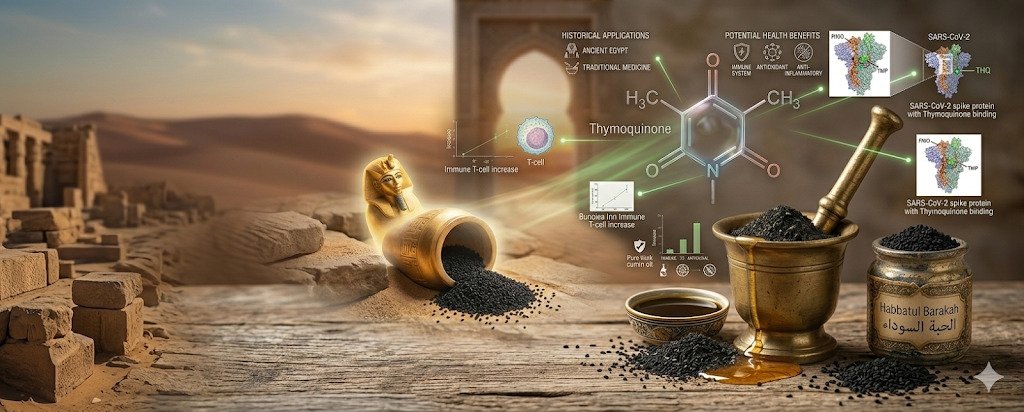
When Howard Carter opened Tutankhamun’s tomb in 1922, a vessel of black seed oil lay among the treasures. The Egyptians did not bury the dead with random objects — they buried them with necessities, with records documenting use for asthma, hypertension, and pain.
1922年,霍华德·卡特打开图坦卡蒙陵墓时,珍宝之中就有一瓶黑种草油。古埃及人不会随意陪葬物品——他们陪葬的是”必需品”,相关记载显示其被用于哮喘、高血压和止痛。
External and Internal Use内服与外用并行
Babylonian medical texts describe the seed used externally for swelling, hair, and bruises, and internally for stomach complaints — one of the earliest written pharmacological records of the plant found anywhere.
巴比伦医学文献记载,此种子被外用于消肿、护发和淤伤,内服则用于治疗胃部不适——这是目前已知关于该植物最早的书面药理学记录之一。
The Book of Isaiah《以赛亚书》
Chapter 28 references the cultivation and careful processing of qetsah — widely identified as Nigella sativa. It was a deliberately cultivated, valued crop, not a wild-gathered curiosity.
第28章记载了对”qetsah”(普遍认为即黑种草)种植与精细加工的描述。它是一种被有意栽培、受到重视的作物,而非随意采集的野生植物。
Dioscorides and the Classical Codification迪奥斯科里德斯的经典记载
Dioscorides documented black seed for headaches, nasal congestion, toothache, and intestinal parasites in De Materia Medica. Hippocrates and Galen both used it to treat fevers and hepatitis.
迪奥斯科里德斯在其《药物论》(De Materia Medica)中记载了黑种草可用于治疗头痛、鼻塞、牙痛和肠道寄生虫。希波克拉底与盖伦都曾用它治疗发热与肝炎。
A Trade Route 3,000km From Home一条离故土三千公里的贸易路线
Archaeologists have recovered black seed at a 2nd-century Roman settlement near the Rhine in present-day Germany — physical proof the seed was already a valuable, imported trade good on the far edge of the empire.
考古学家在今德国境内莱茵河附近一处公元2世纪的罗马定居点遗址中发现了黑种草——这是实物证据,证明这粒种子当时已是罗马帝国边陲地区的珍贵进口商品。
The Prophetic Declaration先知的宣告
The Prophet Muhammad ﷺ declared black seed a healing agent for every disease except death — recorded in both Al-Bukhari and Muslim. Ibn Hajar al-Asqalani later clarified this meant the seed contains the principle of healing. The method was flexible; the promise was not.
先知穆罕默德 ﷺ 宣告黑种草能治愈一切疾病,唯独死亡除外——这一记载同时见于《布哈里圣训集》与《穆斯林圣训集》。伊本·哈贾尔·阿斯卡拉尼其后阐明,这意味着此种子蕴含着”疗愈的原理”。用法可以灵活变通,但这一应许本身是确定的。
Ibn Sina and the Canon of Medicine伊本·西那与《医典》
Ibn Sina (Avicenna), whose Canon of Medicine remained the primary medical textbook in Europe and the Islamic world for over 600 years, documented black seed’s ability to energise the body, stimulate recovery from fatigue, and support respiratory function.
伊本·西那(阿维森纳)所著的《医典》,在欧洲与伊斯兰世界作为主要医学教科书使用超过600年,其中记载了黑种草能够为身体注入活力、帮助从疲劳中恢复,并支持呼吸系统功能。
Çörek Otu — The Everyday Bread SeedÇörek Otu — 日常面包的种子
In Ottoman and modern Turkish kitchens, black seed — called çörek otu — became a baking staple, pressed onto bread and pastry crusts. Medicine and cuisine were never separated; the seed was eaten daily as food, which is precisely how a “dose” survives for centuries.
在奥斯曼帝国及现代土耳其厨房中,黑种草(当地称为çörek otu)成为烘焙的常见配料,常被撒在面包与糕点表皮上。药用与食用从未被割裂开来——正是因为它作为日常食物被持续食用,这种”用量”才得以延续数百年而不曾中断。
Kalonji, the Blessed SeedKalonji,受祝福的种子
Known as kalonji, black seed is a staple of both Unani and Ayurvedic pharmacopeias, prescribed for asthma (zeeq un nafs), diabetes (ziabetus), obesity, hypertension, and dyslipidemia. India is today the world’s largest producer and exporter of the seed.
在印度,黑种草被称为kalonji,是尤纳尼医学与阿育吠陀医学药典中的常用药材,被用于治疗哮喘、糖尿病、肥胖、高血压和血脂异常。如今,印度是全球最大的黑种草生产国与出口国。
A Later but Deliberate Adoption虽晚却仍是有意的吸纳
Black seed entered Chinese herbal formularies via the Silk Road and Islamic trading communities, where it was incorporated into formulations for headache relief — a smaller but genuine thread in TCM’s long history of absorbing foreign botanicals it found useful.
黑种草经由丝绸之路及伊斯兰商贸社群传入中国本草体系,并被纳入用于缓解头痛的方剂之中——这是中医漫长历史中吸收外来、被认为有效的植物药材的又一个真实但相对次要的分支。
A Household Remedy Across the Sahel萨赫勒地区的家常疗方
Across North African and Sahelian folk medicine, black seed has long been used for respiratory complaints, digestive upset, and skin conditions — often alongside honey, mirroring the same “seed plus fat/sugar carrier” logic found independently in Arabia and Anatolia.
在北非及萨赫勒地区的民间医学传统中,黑种草长期被用于呼吸道不适、消化不良及皮肤问题——常与蜂蜜同服,与阿拉伯半岛及安纳托利亚地区独立发展出的”种子加脂肪/糖类载体”逻辑不谋而合。
Habbatus Sauda in the Malaysian Household马来家庭中的黑种草
Black seed is not indigenous to the Malay Archipelago — it arrived through Islamic trade and pilgrimage networks — but it has been fully absorbed into Malaysian and Indonesian households as habbatus sauda, sold in pasar malam stalls, pharmacies, and mosque cooperatives alongside honey and Tongkat Ali, usually as capsules or raw seeds mixed with honey.
黑种草并非马来群岛的原生植物——它是随伊斯兰贸易与朝圣网络传入的——但如今已完全融入马来西亚与印度尼西亚的家庭生活,被称为habbatus sauda,在夜市摊位、药房及清真寺合作社中与蜂蜜、东革阿里一同出售,通常以胶囊形式或与蜂蜜混合的生种子形式服用。
“Every civilisation that encountered this seed — Egyptian, Babylonian, Greek, Roman, Islamic, Indian, Chinese, African, Malay — arrived at a strikingly similar conclusion through independent observation. That is not coincidence. That is convergent evidence across three millennia.” 「每一个曾接触过这粒种子的文明——埃及、巴比伦、希腊、罗马、伊斯兰、印度、中国、非洲、马来——都通过各自独立的观察,得出了惊人相似的结论。这不是巧合,而是横跨三千年的趋同证据。」
What Modern Science Has Found现代科学的发现
21st-century evidence, updated through 202621世纪的实证,更新至2026年
A 2024 comprehensive review in the International Journal of Molecular Sciences confirmed that Nigella sativa has demonstrated clinically relevant effects across gastrointestinal, respiratory, cardiovascular, infectious, and inflammatory conditions. Since then, the evidence base has only grown thicker. According to PubMed, the number of scientific articles mentioning Nigella sativa published annually climbed from 277 in 2015 to 1,265 in 2025 — a more than fourfold increase in a decade.
2024年发表于《国际分子科学期刊》(International Journal of Molecular Sciences)的一篇综合性综述证实,黑种草在消化系统、呼吸系统、心血管、感染性及炎症性疾病方面均表现出具有临床意义的效果。此后,相关证据基础持续增厚。据PubMed数据,每年提及Nigella sativa的科学论文数量,从2015年的277篇上升至2025年的1,265篇——十年间增长超过四倍。
Cardiovascular Health心血管健康
The September 2025 meta-analysis of 82 RCTs found significant reductions in BMI, systolic and diastolic blood pressure, total cholesterol, LDL cholesterol, and triglycerides — improvements across essentially every primary risk factor for heart disease. A separate 2024 meta-analysis focused specifically on endothelial function (three RCTs, 146 patients) found measurable reductions in ICAM and VCAM adhesion molecules, markers of vascular inflammation.
2025年9月发表的这项纳入82项RCT的荟萃分析发现,黑种草能显著降低体重指数(BMI)、收缩压与舒张压、总胆固醇、低密度脂蛋白胆固醇及甘油三酯——几乎覆盖了心脏病的所有主要风险因素。另一项2024年专门针对血管内皮功能的荟萃分析(3项RCT,146名患者)则发现,ICAM与VCAM黏附分子(血管炎症标志物)也出现了可测量的下降。
Blood Sugar and Diabetes血糖与糖尿病
The same 2025 analysis confirmed significantly lowered fasting blood glucose and HbA1c. A 2025 review in Advanced Chinese Medicine (Wiley) found that Nigella sativa oil promotes pancreatic beta-cell survival, stimulates insulin production, and reduces inflammation through multiple simultaneous pathways.
同一项2025年分析证实,黑种草能显著降低空腹血糖与糖化血红蛋白(HbA1c)。2025年发表于《Advanced Chinese Medicine》(Wiley出版)的一篇综述发现,黑种草油能通过多条并行通路,促进胰腺β细胞存活、刺激胰岛素分泌,并降低炎症水平。
Inflammation and Chronic Disease炎症与慢性疾病
The 2025 meta-analysis demonstrated measurable reductions in C-reactive protein (CRP), TNF-α, and interleukin-6 (IL-6) — three key inflammatory biomarkers — alongside a significant decrease in reactive oxygen species. A January 2026 study in the Journal of Burn Care & Research extended this evidence into acute injury, finding reduced inflammatory markers in burn patients.
2025年荟萃分析显示,C反应蛋白(CRP)、肿瘤坏死因子-α(TNF-α)及白细胞介素-6(IL-6)这三项关键炎症生物标志物均出现可测量的下降,活性氧水平也显著降低。2026年1月发表于《Journal of Burn Care & Research》的一项研究,将这一证据进一步延伸至急性创伤领域,发现烧伤患者体内的炎症标志物有所降低。
Immune System Regulation免疫系统调节
Just four weeks of black seed supplementation increased the ratio of helper T-cells to suppressor T-cells by 73% in healthy volunteers and 55% in immunocompromised patients — intelligent modulation of immune function, not simply “boosting” immunity.
仅仅四周的黑种草补充,就能使健康志愿者的辅助性T细胞与抑制性T细胞比例提升73%,在免疫功能低下的患者中也提升55%——这体现的是对免疫功能的智能调节,而非单纯的”增强”免疫力。
Antimicrobial Properties抗微生物特性
Thymoquinone has shown efficacy against MRSA (methicillin-resistant Staphylococcus aureus) while leaving healthy cells unharmed. A 2024 study confirmed significant activity against oral pathogens.
百里醌已被证实对耐甲氧西林金黄色葡萄球菌(MRSA)具有抑制作用,同时不损害健康细胞。2024年的一项研究证实其对口腔病原体也具有显著抑制活性。
Respiratory Health — Now Including Children呼吸系统健康——现已涵盖儿童群体
Clinical studies have shown improvements in pulmonary function in asthma patients, consistent with traditional use across Egyptian, Greek, and Islamic medicine. A trial currently recruiting children aged 6–18 (NCT07315555) is testing oral black seed as adjuvant therapy alongside standard inhaler treatment for moderate persistent asthma — the first dedicated paediatric trial of its kind.
临床研究显示,黑种草能改善哮喘患者的肺功能,这与埃及、希腊及伊斯兰医学中的传统用法一致。目前一项正在招募6至18岁儿童的试验(NCT07315555)正在测试将口服黑种草作为标准吸入治疗的辅助疗法,用于中度持续性哮喘——这是同类中首个专门针对儿童群体的临床试验。
The Elderly — A Growing Focus老年群体——日益受到关注
Dedicated trials in adults over 60 have tested 300mg seed extract twice daily for blood pressure (Indonesia, NCT01393054) and lipid profiles (Indonesia, NCT01531062, 96 participants over 56 days), reflecting growing clinical interest in black seed specifically as a cardiometabolic support for older adults, alongside a 2016 crossover trial finding topical black seed oil comparable to acetaminophen for knee osteoarthritis pain.
已有专门针对60岁以上人群的试验,测试每日两次、每次300毫克种子提取物对血压(印度尼西亚,NCT01393054)及血脂(印度尼西亚,NCT01531062,96名受试者,为期56天)的影响,这反映出临床界对黑种草作为老年心血管代谢支持手段的兴趣日益增长;此外,一项2016年的交叉试验发现,外用黑种草油对膝骨关节炎疼痛的缓解效果与对乙酰氨基酚相当。
Cancer Research — A Growing Frontier癌症研究——一个不断拓展的前沿
A 2025 study in PLOS One demonstrated significant cytotoxicity of thymoquinone against human myelogenous leukaemia cells. A 2025 review in the Journal of Clinical Medicine Research found synergistic effects when thymoquinone was combined with standard chemotherapy drugs for breast cancer. Preclinical research into glioblastoma found thymoquinone inhibits key tumour signalling pathways while crossing the blood-brain barrier. This is promising adjuvant and mechanistic research — not evidence that black seed treats or cures cancer in humans.
2025年发表于《PLOS One》的一项研究显示,百里醌对人类髓系白血病细胞具有显著的细胞毒性。2025年《Journal of Clinical Medicine Research》的一篇综述发现,百里醌与标准乳腺癌化疗药物联用时具有协同效应。针对胶质母细胞瘤的临床前研究发现,百里醌能够穿越血脑屏障并抑制关键的肿瘤信号通路。这些是令人鼓舞的辅助性与机制性研究成果——但并不代表黑种草能够治疗或治愈人体的癌症。
COVID-19 and Antiviral Activity新冠肺炎与抗病毒活性
A clinical trial involving 313 patients in Pakistan found that a combination of honey and black seed produced faster viral clearance, quicker symptom resolution, and lower mortality in COVID-19 patients. Molecular docking studies showed thymoquinone binds to the SARS-CoV-2 spike protein with potency comparable to pharmaceutical candidates.
一项在巴基斯坦开展、纳入313名患者的临床试验发现,蜂蜜与黑种草联合使用能加快新冠病毒清除速度、缩短症状消退时间,并降低死亡率。分子对接研究显示,百里醌与SARS-CoV-2刺突蛋白的结合效力,与部分候选药物相当。
Skin Health皮肤健康
Black seed oil is increasingly documented as an effective topical agent for inflammatory skin conditions including eczema and psoriasis. Its omega-3, -6, and -9 fatty acid content supports the skin barrier, while its antimicrobial and anti-inflammatory properties address underlying causes of common skin complaints.
越来越多文献记载,黑种草油作为一种局部外用制剂,对湿疹、牛皮癣等炎症性皮肤病具有良好效果。其所含的Omega-3、Omega-6及Omega-9脂肪酸有助于支持皮肤屏障功能,而其抗菌与抗炎特性则能针对常见皮肤问题的根本原因发挥作用。
More Than One Molecule不止一种分子
The chemistry behind the blessing祝福背后的化学机制
The pharmaceutical model demands isolation: find the active compound, patent it, scale it. Black seed resists this reductionism. Its power is distributed across over 100 identified phytochemicals working in concert, enhancing each other’s bioavailability and targeting multiple disease pathways simultaneously.
制药模式要求”提纯”:找到活性成分、申请专利、规模化生产。而黑种草天然地抗拒这种简化逻辑。它的效力分散在100多种已被鉴定的植物化学成分之中,这些成分协同作用,相互增强彼此的生物利用度,并同时作用于多条疾病通路。
Thymoquinone (TQ)百里醌(TQ)
The primary active constituent (30–48% of volatile oil). Anti-inflammatory, antioxidant, immunomodulatory, and the main subject of current cancer research.
主要活性成分(占挥发油的30–48%)。具有抗炎、抗氧化、免疫调节作用,也是当前癌症研究的核心对象。
Thymohydroquinone百里氢醌
A natural acetylcholinesterase inhibitor linked to Alzheimer’s-related pathways, with potent antimicrobial properties.
一种天然的乙酰胆碱酯酶抑制剂,与阿尔茨海默病相关通路有关,并具有较强的抗菌特性。
Carvacrol香芹酚
A phenol with documented antibacterial, antifungal, and anti-inflammatory activity. Also found in thyme and oregano.
一种具有记录在案的抗菌、抗真菌和抗炎活性的酚类化合物,也存在于百里香与牛至中。
p-Cymene对伞花烃
A monoterpene that contributes to the antimicrobial spectrum and plays a synergistic role in enhancing thymoquinone’s bioavailability.
一种单萜化合物,有助于拓展抗菌谱,并在协同增强百里醌的生物利用度方面发挥作用。
Alpha-Hederinα-常春藤皂苷
A saponin with documented cytotoxic properties against several cancer cell lines, contributing to the emerging oncological profile.
一种皂苷类成分,已被记录对多种癌细胞株具有细胞毒性作用,是其新兴肿瘤学研究方向的组成部分。
Omega 3, 6 & 9Omega 3、6与9脂肪酸
Essential fatty acids in a favourable ratio — supporting cardiovascular health, skin barrier function, and anti-inflammatory cell signalling.
比例良好的必需脂肪酸——有助于支持心血管健康、皮肤屏障功能,以及抗炎细胞信号传导。
A 2022 Phase 1 randomised, placebo-controlled clinical safety trial administering thymoquinone-rich black seed oil to 70 healthy subjects for 90 days confirmed it to be safe and well-tolerated, with no adverse effects on biochemical or haematological markers.
一项2022年的一期随机安慰剂对照安全性试验,让70名健康受试者连续90天服用富含百里醌的黑种草油,结果证实其安全且耐受性良好,对生化及血液学指标均无不良影响。
The Wrong Default, Applied应用「错误的默认值」
Myth-busting — cutting both ways破除迷思——从两个方向审视
“There is healing in it for every disease”「它能治愈一切疾病」
Taken literally, this claim collapses immediately — no single substance treats every disease, and Ibn Hajar al-Asqalani himself clarified over a thousand years ago that the hadith refers to the seed containing a principle of healing, not a literal universal cure. What’s genuinely remarkable is the breadth: rather than one narrow mechanism, black seed shows measurable, modest effects across cardiovascular, metabolic, inflammatory, immune, and antimicrobial pathways simultaneously. Overclaiming it as a literal cure-all is wrong. Dismissing it as “just another herb” because the literal claim fails is equally wrong.
若按字面理解,这句话立刻站不住脚——没有任何一种物质能治愈所有疾病,而伊本·哈贾尔·阿斯卡拉尼早在千年前便已阐明,这句圣训所指的是种子中蕴含”疗愈的原理”,而非字面意义上的万能特效药。真正值得关注的是它作用范围之广:黑种草并非依靠单一狭窄的机制,而是同时在心血管、代谢、炎症、免疫及抗菌等多条通路上,表现出可测量但温和的效果。把它夸大为字面意义上的万能药是错误的;但因为字面主张不成立就把它简单归为”又一种普通草药”,同样是错误的。
“Black seed cures cancer”「黑种草能治愈癌症」
This claim circulates widely and is not supported by current evidence. What exists is genuinely promising laboratory and preclinical research: thymoquinone shows cytotoxicity against specific cancer cell lines, and synergy when combined with chemotherapy in early studies. None of this constitutes evidence that black seed cures cancer in humans, replaces oncology treatment, or should be used instead of medical care. It is adjuvant, mechanistic, and early-stage — promising research, not a treatment.
这一说法流传甚广,但目前的证据并不支持它。真正存在的,是确实令人振奋的实验室及临床前研究:百里醌对特定癌细胞株表现出细胞毒性,在早期研究中与化疗联用时也显示出协同效应。但这些都不能证明黑种草能治愈人体癌症、可替代肿瘤治疗,或应被用来取代正规医疗。它目前仍属于辅助性、机制性、早期阶段的研究成果——是一个有前景的研究方向,而不是一种治疗手段。
“It’s completely safe for everyone, no interactions”「它对所有人都绝对安全,没有任何相互作用」
Black seed’s excellent safety profile at food and standard supplement doses is well documented — but “excellent” is not “unconditional.” It measurably thins the blood and modulates immune activity, which means real interactions exist with anticoagulants, antiplatelet drugs, and immunosuppressants, and real caution is warranted before surgery and during pregnancy. Traditional endorsement was never a claim of zero risk in every circumstance — it was a claim about a food that is safe for the general population when used sensibly.
在食用及常规补充剂量下,黑种草的安全性记录良好——但”良好”不等于”无条件安全”。它具有可测量的抗凝血作用,并会调节免疫活动,这意味着它与抗凝血药、抗血小板药物及免疫抑制剂之间确实存在相互作用,在手术前及孕期也确实需要谨慎对待。传统上对它的推崇,从来都不是”在任何情况下零风险”的主张,而是”在合理使用下,对一般人群是安全食物”的主张。
“If a little is good, more is better”「少量有效,那多量一定更好」
Clinical dosing in trials clusters in a fairly narrow, moderate range (roughly 1–3g of seed, or 500–2,000mg of extract, daily). There is no established upper limit in the research literature, but that reflects a lack of high-dose safety data — not permission to escalate freely. Case reports of liver enzyme changes exist at high, prolonged doses. The herb-use hierarchy applies here as much as anywhere: consistent, moderate use beats aggressive, inconsistent use.
临床试验中的剂量大多集中在一个相对狭窄、适中的区间(约每日1–3克种子,或500–2,000毫克提取物)。目前研究文献中并未确立明确的用量上限,但这反映的是缺乏高剂量安全性数据——而不是意味着可以随意加量。已有病例报告显示,在长期高剂量使用下出现肝酶变化。草药使用的”层级法则”在这里同样适用:持续、适度的使用,胜过激进而不规律的使用。
“Oil and whole seeds do the same thing”「油和整粒种子的效果是一样的」
Both deliver the same core phytochemical family, but not identically. Cold-pressed oil concentrates the fat-soluble compounds, including thymoquinone, for a more potent single dose. Whole or ground seeds deliver the full fibre and mineral matrix alongside the phytochemicals, and are gentler on the stomach for daily culinary use. Trial data on triglycerides specifically found the oil form significant while the powdered seed form was not. Form matters — it’s not interchangeable by default.
两者提供的核心植物化学成分家族是相同的,但并不完全等效。冷压黑种草油会浓缩脂溶性成分(包括百里醌),单次剂量效力更强;而整粒或磨碎的种子除了植物化学成分外,还保留了完整的纤维与矿物质基质,日常食用对肠胃也更为温和。以甘油三酯为例,试验数据显示油剂形式效果显著,而粉状种子形式则未达到统计学显著性。剂型确实有差异——两者并非默认可以互相替代。
In the News: Reports Worth Knowing新闻实录:值得了解的报道
The whole picture — growth, real cases, and the parts the marketing usually leaves out完整的图景——增长、真实案例,以及营销通常不会告诉你的部分
A Real Case: Surviving Kostmann Syndrome一个真实案例:战胜科斯特曼综合征
A published case report (Al Jaouni et al., Journal of Alternative and Complementary Medicine) documented a patient with Kostmann’s syndrome — a severe congenital condition causing recurrent, life-threatening infections — whose infection burden and survival improved with Nigella sativa and Saudi honey used alongside standard medical care. It’s one case report, not a trial, and is cited here for exactly what it is: a documented, published clinical account, not a viral testimonial.
一篇已发表的病例报告(Al Jaouni等人,《Journal of Alternative and Complementary Medicine》)记录了一名患有科斯特曼综合征(Kostmann’s syndrome)——一种导致反复、危及生命感染的严重先天性疾病——的患者,在标准医疗护理之外配合使用黑种草与沙特蜂蜜后,感染负担有所减轻,生存情况有所改善。这只是一份病例报告,并非临床试验,在此引用它时也如实说明这一点:这是一份有记录、已发表的临床个案,而非网络流传的”神奇见证”。
313 Patients, Four Hospitals: The Pakistan COVID Trial313名患者,四家医院:巴基斯坦新冠试验
Between April and July 2020, researchers at four medical centres in Pakistan ran a genuine randomised, placebo-controlled trial (not a case series) on 313 hospitalised COVID-19 patients with moderate or severe disease. The honey-and-black-seed group cleared the virus faster, recovered symptoms sooner, and had significantly lower 30-day mortality than the placebo group receiving standard care alone — with no reported adverse effects from the treatment. It remains one of the largest randomised trials on black seed ever conducted, and the story behind it — a low-cost intervention tested rigorously in a resource-limited setting during a global emergency — is itself part of the record.
2020年4月至7月间,巴基斯坦四家医疗中心的研究人员针对313名中重度住院新冠患者,开展了一项真正的随机、安慰剂对照试验(而非病例系列报告)。相较于仅接受标准护理的安慰剂组,蜂蜜加黑种草组的患者病毒清除更快、症状恢复更早,30天死亡率也显著更低——且未报告与该疗法相关的不良反应。这仍是迄今为止针对黑种草开展的规模最大的随机试验之一,而其背后的故事——在全球紧急状况下、在资源有限的环境中,对一种低成本干预措施进行严谨检验——本身也是这段记录的一部分。
A $53 Million Market — and What That Attracts一个5300万美元的市场——以及它所吸引来的问题
Black seed oil is now a mainstream supplement category, projected to surpass $53 million in global market value by 2030. In the U.S. alone, it ranked 38th among top-selling herbal ingredients in the mainstream retail channel in 2024, per the American Botanical Council’s Herb Market Report. That growth is a genuine sign of the evidence catching up — and, honestly, it’s also exactly the kind of growth that attracts fraud.
黑种草油如今已成为一个主流的补充剂品类,预计到2030年全球市场规模将超过5300万美元。据美国植物委员会(American Botanical Council)的《草药市场报告》,仅在美国,它在2024年主流零售渠道最畅销草药成分中排名第38位。这样的增长,确实是证据逐渐被追认的真实信号——但坦白说,这也正是最容易招致造假的那种增长。
The Adulteration Problem — Documented, Not Hypothetical掺假问题——有据可查,并非危言耸听
In October 2022, the ABC-AHP-NCNPR Botanical Adulterants Prevention Program published a peer-reviewed bulletin specifically on nigella seed and oil fraud. Genuine cold-pressed black seed oil can be 10 to 30 times more expensive than common vegetable oils — a strong financial incentive to cut it with undisclosed palm, corn, sunflower, soybean, or canola oil, or to substitute the whole seed with a cheaper, similar-looking Nigella species or unrelated seeds. This isn’t a fringe concern raised by critics of the herb — it was published by the same botanical research body that documents and supports the evidence base for herbal medicine generally. It’s precisely why the Petua Corner above tells you to check for a harvest date and a standardised thymoquinone content rather than trust a label on faith.
2022年10月,ABC-AHP-NCNPR植物掺假防治项目(Botanical Adulterants Prevention Program)发布了一份专门针对黑种草种子与油品造假问题的同行评审公告。真正的冷压黑种草油,价格可能是普通食用油的10至30倍——这构成了强烈的经济诱因,促使不法商家在其中掺入未标示的棕榈油、玉米油、葵花籽油、大豆油或菜籽油,或用价格更低、外观相似的其他黑种草属植物种子甚至完全无关的种子来冒充。这并非草药批评者提出的边缘性担忧——它是由同一个记录并支持整个草药医学证据基础的植物研究机构所发布的。这正是为什么上文的”Petua角落”建议你查看收获日期和标准化的百里醌含量,而不是单凭标签上的文字就盲目信任。
FDA Warning Letters — Real, Named, On the RecordFDA警告信——真实存在,有名有姓,白纸黑字
The U.S. FDA has issued multiple documented warning letters to black seed supplement sellers — not for the herb being unsafe, but for two specific, recurring problems: manufacturing facilities failing Good Manufacturing Practice standards (contamination risk from inadequate quality control), and companies marketing black seed products with explicit disease-treatment claims that cross the legal line from “dietary supplement” into “unapproved drug.” One 2020 letter cited a company’s own website quoting scientific literature in a way that implied their product treated specific diseases — precisely the kind of overclaiming this article works to avoid. These are public, on-the-record regulatory actions, not rumours.
美国FDA已向多家黑种草补充剂销售商发出多封有据可查的警告信——原因并非这种草药本身不安全,而是两个具体且反复出现的问题:生产设施未达到良好生产规范(GMP)标准(存在质量控制不足导致污染的风险);以及企业在营销黑种草产品时,明确宣称其可治疗特定疾病,这已越过”膳食补充剂”的法律界限,进入”未经批准药品”的范畴。一封2020年的警告信中,就指出某公司自己的网站引用科学文献的方式,暗示其产品能够治疗特定疾病——这正是本文一直努力避免的那种过度宣称。这些都是公开、有据可查的监管行动,而非道听途说。
None of this contradicts the underlying evidence for black seed’s genuine benefits — the trials cited throughout this article are real, and so is the tradition behind them. But the “no sugarcoating” version of the black seed story includes the fraud, the overclaiming, and the regulatory record, alongside the pharmacology and the history. Buy from a source you trust, check the label, and treat dramatic disease-cure claims — wherever you encounter them — with the same scrutiny you’d want anyone to bring to a hadith.
以上这些都不会否定黑种草真实益处背后的证据——本文所引用的各项试验都是真实存在的,其背后的传统同样真实。但”不加粉饰”版本的黑种草故事,除了药理学与历史之外,也必须包含造假、过度宣称与监管记录。请从你信任的渠道购买,仔细查看标签,并且无论在何处遇到夸张的”治愈疾病”说法,都应以你希望别人对待一则圣训时所抱持的同等审慎态度去看待它。
Bringing It Into Daily Life融入日常生活
The Prophet ﷺ did not prescribe a single method. Ibn Hajar summarised: “It may be used alone, in combination, pulverised, whole, mixed with food, or as a topical dressing.” The key — then and now — is consistency.先知 ﷺ 并未规定单一的用法。伊本·哈贾尔总结道:”它可以单独使用,也可以与其他食物混合、磨碎、整粒,或作为外敷之用。”无论古今,关键都在于持之以恒。
Whole Seeds整粒种子
Swallow directly, crush into food, or brew as tea. Preserves the full phytochemical and fibre spectrum, gentlest on the stomach for daily use.
可直接吞服,压碎后拌入食物,或煮成茶饮。能保留完整的植物化学成分与纤维,日常食用对肠胃最为温和。
Cold-Pressed Oil冷压黑种草油
One teaspoon (5ml) once or twice daily with meals. The most concentrated delivery of thymoquinone. Store in dark glass away from heat — it oxidises quickly once opened.
每日随餐一到两次,每次一茶匙(5毫升)。这是百里醌摄入浓度最高的方式。开封后应存放于深色玻璃瓶中并避免高温,因为它一旦开封氧化速度较快。
With Raw Honey与生蜂蜜同服
Half a teaspoon of black seed oil (or ground seed) with a teaspoon of raw honey. One of the oldest endorsed combinations, with genuine synergistic antimicrobial effects between the two ingredients.
半茶匙黑种草油(或磨碎的种子)与一茶匙生蜂蜜混合服用。这是最古老、最受认可的组合之一,两者之间确实存在真实的抗菌协同效应。
Seed Tea / Infusion种子茶/浸泡饮
Lightly crush 1 teaspoon of seeds and steep in a cup of just-boiled water for 8–10 minutes. Strain, add honey or lemon to taste. A gentle daily ritual, best in the morning or before bed.
将一茶匙种子轻轻压碎,用刚煮沸的水冲泡8至10分钟,滤去种子,可依口味加入蜂蜜或柠檬。这是一种温和的日常仪式,适合早晨或睡前饮用。
Toasted, on Everything烤香后,万物皆可撒
Dry-toast whole seeds in a pan for 30–60 seconds until fragrant — this mellows the bitterness. Sprinkle over hummus, avocado toast, roasted vegetables, salads, or plain yoghurt.
将整粒种子放入干锅中小火烘烤30至60秒,直至散发香气——这能柔化种子的苦味。可撒在鹰嘴豆泥、牛油果吐司、烤蔬菜、沙拉或原味酸奶上。
Baked In烘焙入面
Follow the Ottoman and South Asian tradition: press whole seeds onto naan, roti, or bread dough before baking. A savory cake or flatbread with a teaspoon of ground seed folded into the dough works just as well.
沿袭奥斯曼与南亚的传统做法:在烘烤前,将整粒种子按压在馕、印度薄饼(roti)或面团表面。也可在面团中拌入一茶匙磨碎的种子,制作咸味蛋糕或薄饼,同样有效。
In Cooking — Dhal, Curry, Marinade入菜——豆汤、咖喱、腌料
Stir a pinch of ground seed into lentil dhal, curry, or a meat marinade near the end of cooking — high, prolonged heat degrades the more delicate volatile compounds, so add late rather than at the start.
在烹调接近尾声时,将少许磨碎的种子拌入扁豆汤(dhal)、咖喱或肉类腌料中——因为高温长时间加热会破坏较为脆弱的挥发性成分,所以应在最后阶段加入,而非一开始就下锅。
Smoothie or Salad Dressing冰沙或沙拉酱
Blend a teaspoon of ground seed into a morning smoothie, or whisk it into a simple vinaigrette of olive oil, lemon juice, and a touch of honey.
将一茶匙磨碎的种子加入早晨的冰沙中打匀,或与橄榄油、柠檬汁及少许蜂蜜一起搅拌,制成简单的油醋汁。
Capsules / Standardised Powder胶囊/标准化粉末
For those who find the taste too strong, encapsulated powder or oil provides a measured, consistent daily dose. Look for products listing a standardised thymoquinone content.
对于觉得味道过重的人,胶囊装的粉末或油剂能提供分量精确、稳定一致的每日剂量。选购时应留意产品标签上是否标明标准化的百里醌含量。
Topical Application外用
Apply oil directly to affected skin for eczema, psoriasis, acne, or joint discomfort. Blend with olive or coconut oil for sensitive skin, or for a larger surface area like a sore joint.
可将黑种草油直接涂抹于患处,用于湿疹、牛皮癣、痤疮或关节不适。若肌肤敏感,或需涂抹较大范围(如疼痛的关节),可与橄榄油或椰子油混合稀释后使用。
Steam Inhalation蒸汽吸入
A few drops of oil in a bowl of hot water, inhaled as vapour with a towel over the head. Supports the respiratory system and eases sinus congestion.
在一碗热水中滴入几滴黑种草油,头上盖一条毛巾吸入蒸汽。有助于支持呼吸系统,缓解鼻窦充血。
Grinding & Storage研磨与保存
Whole seeds are more shelf-stable than ground powder. Grind only what you’ll use in 2–3 days in a coffee or spice grinder just before use, and store in an airtight jar away from light and heat.
整粒种子比磨碎后的粉末更耐储存。建议在使用前用咖啡磨或香料磨少量研磨,仅磨出2至3天的用量,并存放于避光、避热的密封罐中。
How Much, For Whom用量几何,因人而异
Reference ranges drawn from culinary tradition and clinical trial dosing — not a personal prescription以下参考范围综合了饮食传统与临床试验的用量——并非针对个人的处方建议
| Life Stage人生阶段 | Typical Reference Range典型参考范围 | Notes备注 |
|---|---|---|
| Adults (general)成人(一般人群) | 1–3g whole/ground seed (½–1 tsp) daily, or 2.5–5ml oil once–twice daily, or 500–2,000mg standardised extract每日1–3克整粒或磨碎的种子(约½–1茶匙),或每日1–2次、每次2.5–5毫升油,或每日500–2,000毫克标准化提取物 | This is the range most commonly used in trials showing benefit. Start at the low end.这是多数显示出益处的临床试验中最常采用的范围。建议从较低剂量开始。 |
| Elderly (60+)老年人(60岁以上) | 300mg extract twice daily used in published trials已发表试验中采用每日两次、每次300毫克提取物 | Start low, especially alongside blood pressure or lipid medication — the effects are additive, not neutral.应从低剂量开始,尤其是同时服用降压或降脂药物时——两者的作用是叠加的,而非互不相干。 |
| Children & adolescents (6–18)儿童及青少年(6–18岁) | Traditional food-level use (a pinch on bread, in honey) is considered safe; concentrated supplement dosing is still under clinical study传统食用级别的用量(如撒在面包上、与蜂蜜同服的少量)被视为安全;浓缩补充剂的用量目前仍处于临床研究阶段 | Do not give concentrated oil or capsules to children without paediatric guidance — the supplement-dose evidence base is still thin.未经儿科医生指导,请勿给儿童服用浓缩油剂或胶囊——目前针对补充剂剂量的证据基础仍然有限。 |
| Pregnancy孕期 | Food-spice-level use is traditional and generally considered low-risk; concentrated extracts and oil in supplement doses are not recommended调味品级别的传统食用一般被认为风险较低;不建议在孕期服用补充剂剂量的浓缩提取物或油剂 | Some traditional and preclinical data flag a possible uterotonic effect at concentrated doses. Discuss with your obstetrician before supplementing.部分传统用法及临床前数据提示,浓缩剂量可能具有一定的子宫兴奋作用。补充前请务必与产科医生讨论。 |
| Breastfeeding哺乳期 | Traditionally used as a galactogogue in India and Iran; no controlled trial data confirms this or establishes an infant-safe dose在印度与伊朗传统上被用作催乳食材;但目前尚无对照试验数据证实其效果,也未确立对婴儿安全的用量 | No data exists on excretion into breastmilk. Food-level use is common practice; supplement-level use should be discussed with a healthcare provider.目前尚无关于其成分是否会经母乳排出的数据。食用级别的使用较为常见;补充剂级别的使用应与医疗专业人员商议。 |
| On anticoagulant / antiplatelet medication正在服用抗凝血/抗血小板药物者 | Medical supervision required需在医生监督下使用 | Black seed’s mild blood-thinning effect is additive with warfarin, aspirin, and similar drugs.黑种草本身具有轻微的抗凝血作用,与华法林、阿司匹林等药物合用时效果会叠加。 |
| Renal or hepatic impairment肾功能或肝功能受损者 | Consult specialist before supplement-level use在使用补充剂级别的用量前,请咨询专科医生 | Case reports of liver enzyme changes exist at high, prolonged doses — impaired clearance changes the risk calculation.已有病例报告显示,在长期高剂量使用下出现肝酶变化——若代谢清除能力受损,风险评估也需相应调整。 |
The FDA lists Nigella sativa as Generally Recognized As Safe (GRAS) at culinary, spice-level use. This table reflects published research ranges and traditional practice — it is not a personalised medical recommendation. See the Caution section below. 美国食品药品监督管理局(FDA)将黑种草列为”一般公认安全”(GRAS)的调味品级别用量。本表格反映的是已发表研究中的用量范围与传统使用习惯——并非针对个人的医疗建议。请参阅下方的”注意事项”部分。
Population trials tell you what happens to the average person in a study of a few dozen or a few hundred people. They don’t tell you what happens to you. That’s not a criticism of the science — it’s just what averages are for. If you want to know your own response, you have to actually watch it, deliberately, for long enough to separate signal from noise. That’s not woo. It’s a real, published research method called an N-of-1 trial, and it’s exactly the “get curious, not panicked” instinct this site has always argued for.
群体试验告诉你的,是在一项纳入数十或数百人的研究中,”平均”会发生什么。它们无法告诉你,你自己会发生什么。这并不是在批评科学——平均值本来就是用来做这件事的。如果你想了解自己的真实反应,就必须刻意地、持续足够长的时间去观察,才能把真实信号从噪音中分辨出来。这并非玄学,而是一种真实存在、已发表的研究方法,叫做”N-of-1试验”(单人试验)——这恰恰正是本站一直提倡的”保持好奇,而非恐慌”的态度。
Proposing a Protocol: Should You Run Your Own?提出一个方案:你该不该为自己做一次试验?
AJ’s honest take, plus a practical self-observation designAJ 的坦率看法,以及一份实用的自我观察设计
Here’s my honest opinion on proposing a formal protocol for black seed: I think it’s worth doing, but only if it’s built with enough discipline to actually answer a question — not just “I took it for two weeks and felt fine,” which tells you almost nothing. The strongest case for black seed isn’t any single trial; it’s the pattern across dozens of small, methodologically modest trials plus three thousand years of consistent traditional use. A well-run personal protocol adds one more honest data point to that pattern — your own.
关于是否应为黑种草制定一套正式方案,我的坦率看法是:这件事值得做,但前提是要有足够的严谨度,才能真正回答一个问题——而不是”我吃了两周,感觉还不错”这种几乎说明不了任何问题的说法。黑种草最有说服力的地方,从来不是某一项单一试验,而是数十项方法论上相对朴素的小型试验,加上三千年持续不断的传统使用所形成的模式。一套设计得当的个人方案,正是为这个模式再添上一个诚实的数据点——属于你自己的那一个。
A Practical Self-Observation Protocol一份实用的自我观察方案
Modelled loosely on the N-of-1 trial design used in personalised medicine research — a method where you serve as your own control, before-and-after.
大致仿照个性化医学研究中使用的”N-of-1″试验设计——一种由你自己充当自身对照组的前后对比方法。
Pick ONE goal, not five只选定一个目标,而非五个
Blood pressure, fasting glucose, joint stiffness, energy, digestion — choose the one thing you actually want to know about. Trying to track everything at once means you’ll learn nothing clearly about anything.
血压、空腹血糖、关节僵硬、精力、消化状况——选出你真正想了解的那一项。如果试图同时追踪所有指标,最终往往对任何一项都得不出清晰的结论。
Baseline — 2 weeks, no black seed基线期——两周,不服用黑种草
Track your chosen marker daily before introducing anything. Home BP cuff, a fasting glucose reading, a simple 1–10 self-rated diary — whatever fits the goal. This is the number everything else gets compared against.
在开始使用前,先每日追踪你所选定的指标。可使用家用血压计、空腹血糖读数,或简单的1至10分自评日记——根据目标选择合适的方式。这个基线数值,是之后一切比较的参照标准。
Intervention — 8–12 weeks, one form, one dose, same time干预期——8至12周,固定剂型、固定剂量、固定时间
Pick one delivery method (say, 1 tsp oil with breakfast) and hold it steady. Don’t switch between seeds, oil, and capsules mid-protocol — you won’t know which change caused what. Keep logging the same marker on the same schedule.
选定一种服用方式(例如早餐时服用一茶匙油),并保持一致,切勿在方案进行期间随意更换种子、油或胶囊——否则你将无法判断究竟是哪个变化导致了结果。继续按相同时间表记录同一项指标。
Hold everything else as steady as you honestly can尽量诚实地保持其他一切因素不变
This is the “no single number, no single pill” principle in action — diet, sleep, stress, and exercise all move the same markers you’re tracking. You’re not trying to eliminate those variables (that’s impossible in real life), just trying not to change them dramatically mid-protocol so black seed isn’t unfairly credited or blamed for something else.
这正是”没有单一数字,没有单一药丸”这一原则的具体实践——饮食、睡眠、压力和运动,都会影响你正在追踪的同一批指标。你并非要彻底消除这些变量(在现实生活中这不可能做到),而是要避免在方案进行期间让它们发生剧烈变化,以免把功劳或过错错误地归到黑种草头上。
Optional — washout and re-challenge可选步骤——洗脱期与再次验证
For a more rigorous read, stop for 2–4 weeks after the intervention phase and see if the marker drifts back toward baseline, then reintroduce it. If the pattern repeats — improvement, drift back, improvement again — that’s a much stronger personal signal than a single before/after comparison.
若想获得更严谨的结果,可在干预期结束后停用2至4周,观察指标是否回落至基线水平,随后再重新服用。若观察到”改善——回落——再次改善”的重复模式,那将是比单次前后对比更有力的个人信号。
Loop in a professional for anything clinical涉及临床指标时,务必让专业人士参与
If your marker is blood pressure, glucose, or a lipid panel — especially if you’re on medication — do this alongside your doctor, not instead of them. A self-tracked protocol is a way to bring better, more honest data to that conversation, not a way to avoid it.
如果你追踪的指标是血压、血糖或血脂——尤其是在你正在服药的情况下——应与医生共同进行,而不是取而代之。自我追踪方案的意义,是为与医生的沟通带来更准确、更真实的数据,而不是用来回避这场对话。
This is offered as a thinking framework, not medical advice. If you’re monitoring a diagnosed condition, build this alongside — never instead of — your treating physician.
以上内容仅作为一种思考框架提供,并非医疗建议。若你正在监测某项已确诊的疾病,请务必与主治医生共同制定此方案,而非取而代之。
Petua Corner — Practical TipsPetua 角落——实用小贴士
- Buy whole seeds where possible — pre-ground powder loses potency faster and is easier to adulterate.尽量购买整粒种子——预先磨好的粉末失效更快,也更容易掺假。
- Good seeds smell peppery and slightly bitter, almost oregano-adjacent, when crushed. If there’s no smell, they’re old.优质的种子在压碎后会散发出胡椒般的香气,带一点苦味,接近牛至的气味。若压碎后毫无气味,说明种子已经过期。
- For oil, check the label for cold-pressed and look for a harvest or expiry date — black seed oil oxidises and turns rancid faster than most cooking oils.购买油品时,请留意标签上是否注明”冷压”,并查看收获或有效期日期——黑种草油比大多数食用油更容易氧化变质。
- In Malaysia, habbatus sauda capsules and honey blends are widely available at pharmacies and mosque cooperatives — check for a standardised thymoquinone content on the label rather than relying on brand name alone.在马来西亚,habbatus sauda 胶囊及蜂蜜混合产品在药房与清真寺合作社中随处可见——购买时应查看标签上是否标明标准化的百里醌含量,而不要只凭品牌名称判断。
- If the raw taste is too strong, start with the honey combination before moving to oil or capsules — it’s the gentlest entry point and the most historically endorsed.若觉得原味过于浓烈,可先从蜂蜜混合的吃法开始,再逐步过渡到油剂或胶囊——这是最温和的入门方式,也是历史上最受推崇的吃法。
- Consistency beats intensity. A small daily amount for months matters more than a large amount for a week.持之以恒胜过一时猛烈。连续数月的少量摄入,远比一周内的大量摄入更有意义。
Honest Limitations诚实的局限性
Most clinical trials on black seed are small (often under 100 participants) and short (weeks to a few months) — genuinely useful signal, but not the large, decades-long outcome data pharmaceutical drugs are held to. Effect sizes across the 2025 meta-analysis are real but modest, not dramatic. Much of the cancer, antiviral, and neuroprotective research remains preclinical or laboratory-stage. And traditional use across three thousand years, while a meaningful form of evidence, is not the same thing as a controlled trial — it tells us the seed is broadly safe and broadly useful, not that it works for any specific person’s specific condition.
大多数黑种草的临床试验规模较小(通常不足100人),持续时间也较短(数周至数月)——这些数据确实是有意义的信号,但还达不到药品所需的那种大规模、长达数十年的结局数据标准。2025年荟萃分析中的效应量是真实存在的,但属于温和而非显著的水平。大量关于抗癌、抗病毒及神经保护的研究,仍停留在临床前或实验室阶段。而三千年的传统使用,虽然是一种有意义的证据形式,却不能等同于对照试验——它告诉我们的是,这粒种子在总体上是安全且有用的,而不是它对某个具体的人、某种具体的病症一定有效。
Caution注意事项
While black seed has an excellent safety profile at standard doses, it should not be used concurrently with anticoagulant or antiplatelet medication (such as warfarin, aspirin, or clopidogrel) without medical supervision, due to its own mild blood-thinning effect. It is not recommended in supplement or concentrated form during pregnancy. Because it measurably modulates immune activity, those on immunosuppressant therapy or with autoimmune conditions should consult their treating physician before use. Stop concentrated use at least two weeks before any scheduled surgery. Concentrated supplement dosing in children should be guided by a paediatrician; food-level culinary use is generally considered safe. Those with renal or hepatic impairment, or on any prescription medication, should consult a qualified healthcare provider before supplementing. These statements have not been evaluated by regulatory authorities. Black seed is not intended to diagnose, treat, cure, or prevent any disease.
尽管黑种草在标准剂量下具有良好的安全记录,但由于其本身具有轻微的抗凝血作用,若未经医生指导,不应与抗凝血或抗血小板药物(如华法林、阿司匹林或氯吡格雷)同时使用。不建议在孕期以补充剂或浓缩形式服用。由于它会明显调节免疫活动,正在接受免疫抑制治疗或患有自身免疫性疾病者,使用前应咨询主治医生。任何预定手术前,应至少提前两周停止浓缩形式的使用。儿童服用浓缩补充剂的用量应由儿科医生指导;食物调味品级别的日常食用一般被认为是安全的。肾功能或肝功能受损者,以及正在服用任何处方药物者,在补充前应咨询合格的医疗专业人员。以上陈述未经监管机构评估。黑种草不用于诊断、治疗、治愈或预防任何疾病。
Why Has It Taken This Long?为什么等了这么久?
The evidence for black seed spans 3,300 years of recorded history, validated by more than a dozen independent civilisations, the world’s most authoritative physician, a prophetic declaration, and now over 130 clinical trials. The question is not whether it works. The question is why it has taken so long for this information to reach the mainstream conversation about health.
黑种草的证据横跨3,300年的记载历史,得到了十几个彼此独立的文明、世界最具权威性的医师、一则先知宣告的验证,如今更有超过130项临床试验作为支撑。问题从来不是它是否有效,而是为什么这些信息花了这么久,才进入健康领域的主流讨论。
Part of the answer is structural: the pharmaceutical model requires patents, and you cannot patent a seed. There is no financial incentive to fund large-scale clinical trials for a botanical anyone can buy for a few ringgit at a market stall. But the tide is turning. Researchers are arriving. Trials are being registered. Meta-analyses are being published. And what they are finding is not a primitive folk remedy awaiting validation — it is a medicinal system that anticipated, by centuries, what molecular biology is now beginning to decode.
部分原因在于结构性问题:制药模式依赖专利,而一粒种子是无法申请专利的。对于任何人只需花几令吉就能在市场摊位买到的植物,投入资金进行大规模临床试验并没有商业诱因。但这一局面正在转变。研究者正在涌入,试验正在被注册,荟萃分析正在被发表。而他们所发现的,并非一种等待被验证的原始民间偏方,而是一套早在数百年前,就已预见到分子生物学如今才刚刚开始解码的内容的医疗体系。
The black seed does not need science to legitimise it. Science is catching up to the black seed.
黑种草从不需要科学来赋予它正当性。是科学,正在追赶黑种草。
References & Sources (click to expand)参考文献与资料来源(点击展开)
- Al-Bukhari. Sahih Al-Bukhari, Hadith 5688; Muslim. Sahih Muslim, Hadith 2215.
- Carter, H. (1922). Findings from the Tomb of Tutankhamun. Egyptian Museum, Cairo.
- Dioscorides, P. (c. 65 CE). De Materia Medica.
- Ibn Sina. Al-Qanun fi al-Tibb, c. 1025 CE.
- Ibn Hajar al-Asqalani. Fath al-Bari, Vol. 10.
- Book of Isaiah 28:25–27, Hebrew Bible.
- Ioniță-Mîndrican, C.B. et al. (2024). Nigella sativa: A Comprehensive Review. International Journal of Molecular Sciences, 25(24), 13410.
- Pandey, R. et al. (2025). Updated review on Nigella sativa phytochemistry. Advanced Chinese Medicine, Wiley.
- Vinceti, M. et al. (2025). Meta-analysis of 82 RCTs on black seed cardiometabolic outcomes. Pharmacological Research (Sept 2025).
- Vinusri, S. et al. (2025). Anticancer potential of Thymoquinone. PLOS One. PMC12161580.
- Khan, M. et al. (2025). TQ-Chemotherapeutic Combinations for Breast Cancer. Journal of Clinical Medicine Research, 17(5), 270–284.
- Ashraf, M. et al. (2021). Honey and Nigella sativa in COVID-19, 313-patient trial, Pakistan.
- Akhondian, J. et al. (2022). Phase I safety trial of thymoquinone-rich black seed oil, 90 days.
- Ali, M. et al. (2024). Endothelial Function Responses to Nigella sativa Supplementation: Systematic Review and Meta-Analysis. Cureus, DOI: 10.7759/cureus.61047.
- J Burn Care Res (2026, Jan 22). Nigella sativa / thymoquinone in burn inflammation. PMID: 41575220.
- ClinicalTrials.gov NCT07315555. Oral Nigella Sativa as Adjuvant Therapy in Children With Moderate Persistent Asthma.
- ClinicalTrials.gov NCT01393054. Effect of Nigella Sativa Seed Extract on Blood Pressure of Elderly With Hypertension.
- ClinicalTrials.gov NCT01531062. Effect of Nigella Sativa on Lipid Profiles in Elderly.
- Al-Naqeep, G. et al. Crossover RCT on black seed, IL-1β, IL-6, leptin and insulin in overweight/obese women. BMC Complementary Medicine and Therapies.
- Motherfigure (2022). Black Seed / Nigella sativa and Pregnancy — LactMed-derived summary.
- MedShadow / PubMed trend analysis (2025). Nigella sativa annual publication counts, 2015–2025.
- “Nigella sativa” — 130+ trials identified on ClinicalTrials.gov, 2026.
- Traditional and modern usage of Nigella sativa across Ayurvedic, Unani, Siddha, TCM, Arabic, and African medicine — multiple ethnobotanical reviews, 2009–2024.
- McCormick Science Institute; Gaiaherbs ethnobotanical summaries — archaeological and historical distribution notes.
- Ibn Hajar al-‘Asqalani, A. Fath al-Bari Sharh Sahih al-Bukhari, ed. M.F. ‘Abd al-Baqi (Beirut: Dar al-Ma’rifah), 10/144–145.
- Ibn Qayyim al-Jawziyyah, M. at-Tibb al-Nabawi (Beirut: Dar al-Hilal), 1/223; and Zad al-Ma’ad.
- Ibn Battal, A.H.A. Sharh Sahih al-Bukhari li Ibn Battal, ed. A.T.Y. Ibrahim (Riyadh: Maktabah al-Rushd, 2003), 9/397.
- al-Wahidi, A.A. al-Tafsir al-Basit (Jami’ah al-Imam Muhammad bin Sa’ud al-Islamiyyah, 1430), 14:117; 17:206–207.
- Jabatan Mufti Wilayah Persekutuan (Malaysia). Irsyad al-Hadith Series 517: Understanding the Hadith ‘Habbatussauda’ is a Remedy to All Illnesses. 12 March 2021.
- Rabbani, F. (SeekersGuidance). Am I Sinful for Not Using Black Seed After Finding No Benefit? 11 May 2026.
- Sahih al-Bukhari 5687, 5688; Sahih Muslim 2215 — primary hadith texts, Abu Hurairah and Aisha (RA) narrations.
- Sahih Muslim — date-palm pollination hadith (“You know better the affairs of your world”).
- Al Jaouni, S.K. et al. (2017). Nigella sativa and Saudi honey diminish infections and improve survival in a Kostmann’s syndrome patient: Case report. Journal of Alternative and Complementary Medicine, 8(3), 119.
- Ashraf, S. et al. (2022). Honey and Nigella sativa against COVID-19 in Pakistan (HNS-COVID-PK): Multicenter placebo-controlled RCT. Phytotherapy Research, 37, 627–644.
- Adrien, C. (2026). Not a one-condition remedy: The legacy and promise of ‘blessed’ black seed oil. NutraIngredients, 11 May 2026.
- Orhan, N. (2022). Adulteration of Nigella (Nigella sativa) Seed and Seed Oil. Botanical Adulterants Prevention Bulletin. Austin, TX: ABC-AHP-NCNPR Botanical Adulterants Prevention Program.
- U.S. FDA. Warning Letters: Black Seed Herb, Inc. (515581, 11 July 2017); KetoKerri LLC (598163, 31 March 2020) — disease-claim and CGMP violations.
- American Botanical Council Herb Market Report (2024) — U.S. mainstream and natural channel sales rankings.