The Pain the Body
Keeps Remembering
Kaempferia galanga — topical pain relief, nerve pain, and the ethyl cinnamate mechanism that Western herbalism calls arnica
After nerve damage from my military discharge, certain areas of my body held a dull, persistent ache — not the sharp pain of injury, but the kind that feels like the body is remembering something it wants to forget. The Orang Asli ground Cekur into a paste and applied it directly. The ache subsided. That is where this article begins — and where the pharmacology of Kaempferia galanga gets interesting.
What the Orang Asli Said About Cekur
“For pain. For when the body keeps remembering what it wants to forget.”
The Orang Asli ground it into a paste and applied it to aching muscles and stiff joints. They were not describing a warming sensation or a pleasant smell — they were describing a specific clinical outcome in the language they had for it. The body keeps pain somewhere after an injury. This plant, applied directly, gives it permission to let go.
After my nerve injury, some areas just ached persistently. Not the sharp pain of damage — the dull, low-grade, chronic kind that feels like a memory the nervous system can’t release. I applied Cekur paste directly. The local pain reduced noticeably.
What I noticed: significant reduction in localised pain after topical application. And something I hadn’t expected — the young shoots, eaten raw like a salad, tasted quite good. A completely different experience from the intense flavour of the dried root. If you can find fresh Cekur, try the shoots first. It is a gentler introduction to the plant.
My primary use: topical paste for localised pain. Occasionally a light tea — one thin slice, simmered five minutes.
The Western analog the herbalism literature offers is arnica — topical, anti-inflammatory, used for bruising and muscle pain. The pharmacological comparison is appropriate: both work primarily through topical mechanisms. But Cekur’s ethyl cinnamate and ethyl p-methoxycinnamate are not arnica’s helenalin. Different compounds, overlapping application. And Cekur grows throughout Malaysia, accessible without import.
What the Evidence Shows
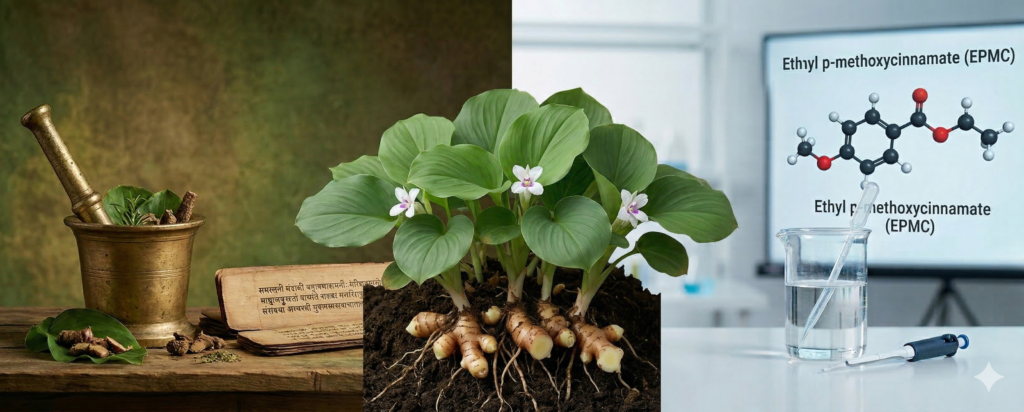
Ethyl p-methoxycinnamate (EPMC) — the dominant volatile compound in Kaempferia galanga. Anti-inflammatory, analgesic, antifungal, and cytotoxic properties documented. The compound responsible for most of the pharmacological activity.
EPMC demonstrates COX-2 inhibitory activity — the same target as commercial NSAIDs including ibuprofen and diclofenac. The anti-inflammatory mechanism is pharmacologically convergent with the drugs most people reach for first.
Malaysia / Indonesia (Cekur/Kencur), India / Ayurveda (Sugandha Vachi), and Thailand (Krachai) all independently documented the same topical pain and respiratory applications.
Young Cekur shoots are eaten raw in Malaysian salads (ulam) and kerabu. The plant is simultaneously a kitchen herb and a pharmacy. The culinary application is not separate from the medicinal one.
Acetylcholinesterase inhibitory activity documented — the same mechanism as pharmaceutical Alzheimer’s drugs donepezil and rivastigmine. Research is preliminary but the mechanism is not trivial.
Different preparation methods deliver different compound profiles to different targets. The traditional knowledge preserved both applications — topical paste for pain, internal decoction for respiratory and digestive conditions.
Five Things That Reframe Cekur
The topical pain relief mechanism is COX-2 inhibition — the same target as ibuprofen and diclofenac. The traditional paste application is a localised NSAID.
Ethyl p-methoxycinnamate (EPMC) demonstrates COX-2 inhibitory activity in documented studies. COX-2 is the cyclooxygenase enzyme responsible for prostaglandin-mediated inflammation and pain. When the Orang Asli ground Cekur and applied it to a painful joint, they were performing localised COX-2 inhibition without knowing what COX-2 was. The mechanism explains the empirical observation.
The young shoots are eaten raw in Malaysian salads — making Cekur simultaneously a kitchen herb and a medicine. Most people eat it without knowing they are taking a pharmacological substance.
Nasi ulam and kerabu preparations include raw young Cekur shoots. The culinary dose is lower than the medicinal dose, but the compounds are the same. The wrong default is treating Cekur as either food or medicine. It is both. The boundary was never there in traditional Malaysian practice.
EPMC — the dominant active compound — has documented antifungal, antibacterial, and cytotoxic activity alongside its anti-inflammatory role. This is a broad-spectrum plant.
EPMC demonstrates activity against Candida and dermatophytes (topical antifungal), multiple bacterial species (antimicrobial), and cytotoxic activity against several cancer cell lines in vitro. The Orang Asli’s use for skin conditions alongside muscle pain reflects this multi-mechanism profile — they observed outcomes across multiple applications, and the chemistry explains all of them.
Acetylcholinesterase inhibitory activity has been documented — placing Cekur in the same mechanistic category as Alzheimer’s drugs donepezil and rivastigmine.
AChE inhibition prevents the breakdown of acetylcholine, maintaining neurotransmitter availability at synaptic junctions. This is the mechanism pharmaceutical memory drugs use. The research on Kaempferia galanga is preliminary — but the mechanism is serious. Cekur is not an Alzheimer’s treatment. It is, however, a plant whose extract engages the same pharmacological target.
Cekur is Kaempferia galanga, not Kaempferia rotunda (Temu Kunci / Fingerroot) and not regular ginger. Three plants with overlapping common names causing persistent consumer confusion.
Kaempferia galanga = Cekur (Sand Ginger). Kaempferia rotunda = Temu Kunci / Fingerroot. Zingiber officinale = Ginger. All three are in the Zingiberaceae family, all have rhizomes, all are used in Southeast Asian cooking and medicine. They are not interchangeable. EPMC is specific to Kaempferia galanga. Verify the Latin name before purchasing.
One Plant Across Many Cultures
The primary Malay name. Used both as a culinary herb (young shoots in ulam and kerabu) and as a medicinal paste for localised pain. Widely available in traditional markets across Malaysia.
The Indonesian name. Significant culinary presence in Javanese cuisine — kencur rice (nasi kencur), kencur sambal. The medicinal applications parallel Malaysia’s Cekur use. The plant’s dual food-medicine identity is consistent across both countries.
Thai use focuses on the respiratory applications — Cekur decoctions for cough and throat conditions. The same plant, different primary application emphasis, reflecting different regional traditional priorities with the same pharmacological reality.
“Fragrant Vacha.” Ayurvedic use documented for respiratory conditions, as a carminative, and for cognitive applications. The AChE inhibitory activity documented in modern research may explain the traditional cognitive application.
“Sand Ginger” — grows in sandy, well-drained soil rather than the moist conditions of regular ginger. “Resurrection Lily” refers to the plant’s beautiful white and purple flowers that emerge from seemingly bare soil.
Family Zingiberaceae. Named after Engelbert Kaempfer, 17th-century German physician who documented Southeast Asian plants during his travels. Small rhizome with distinctive aromatic compounds not found in other Zingiberaceae members.
What Cekur Actually Contains
Kaempferia galanga’s pharmacological profile is dominated by its volatile oil fraction — particularly the cinnamate esters that give the plant its characteristic penetrating aroma. These are not the same compounds as in ginger (gingerols) or turmeric (curcuminoids). Cekur is chemically distinct from every other Zingiberaceae member in common use.
Ethyl p-methoxycinnamate (EPMC)
The dominant volatile compound. Anti-inflammatory via COX-2 inhibition, analgesic, antifungal, antibacterial, and cytotoxic properties documented. Responsible for most of the pharmacological activity. Penetrates the skin — explaining the topical application’s efficacy. The compound that makes the paste work.
Ethyl Cinnamate
The second primary volatile compound. Anti-inflammatory and analgesic activity alongside EPMC. Also responsible for the plant’s characteristic floral-spicy aroma — the scent marker that distinguishes Cekur from other rhizomes in the market. If it doesn’t smell like Cekur, verify the species.
Kaempferol & Flavonoids
Note: the plant genus is named for Kaempfer, not for kaempferol — but Kaempferia galanga does contain kaempferol. Synergistic anti-inflammatory and antioxidant activity alongside the cinnamate esters — broadening the anti-inflammatory spectrum beyond COX-2 into antioxidant and NF-κB pathways.
AChE-Inhibitory Compounds
The specific compound(s) responsible for the documented acetylcholinesterase inhibitory activity have not been fully characterised. The activity is present in the ethanol extract. Research is preliminary — but the mechanism places Cekur in the same pharmacological category as pharmaceutical cognitive drugs.
Cineole & Borneol
Respiratory-relevant volatile compounds. Cineole (also in eucalyptus) has documented bronchodilatory and antimicrobial activity in the respiratory tract — directly explaining the traditional use of Cekur decoctions for cough, congestion, and throat conditions across Thailand, India, and Malaysia.
Starch & Mucilage
The rhizome’s starch and mucilage content serves as the physical matrix for the topical paste preparation. The mucilage forms a protective film on skin surfaces — keeping the active volatile compounds in contact with the target tissue longer than a simple liquid preparation would allow.
Three Research Areas
COX-2 Inhibition: When the Traditional Paste Meets Pharmacology
Ethyl p-methoxycinnamate (EPMC) demonstrates COX-2 inhibitory activity in documented pharmacological studies. COX-2 is the inducible cyclooxygenase enzyme that drives prostaglandin-mediated inflammation and pain — the same target as ibuprofen, diclofenac, and celecoxib. The anti-inflammatory and analgesic effects of the Cekur paste have a specific, identified molecular mechanism.
The topical route of administration is pharmacologically appropriate: EPMC penetrates skin barriers efficiently, delivering the compound directly to the inflamed tissue underneath. This is the same principle as topical diclofenac gels — direct delivery to the target, bypassing systemic distribution. The traditional paste preparation is, in modern pharmacological terms, a topical COX-2 inhibitor.
Ethyl cinnamate contributes additional analgesic activity alongside EPMC. The combination in the whole-rhizome paste delivers synergistic anti-inflammatory and analgesic effects that isolated EPMC alone does not fully replicate — consistent with the broader pattern across herbal medicine where whole-plant preparations outperform isolated compounds.
EPMC COX-2 inhibitory activity: documented in pharmacological studies. Topical penetration and analgesic mechanism characterised. Multiple studies on Kaempferia galanga anti-inflammatory activity.
Cineole, Borneol, and the Traditional Cough Decoction
The respiratory applications of Kaempferia galanga documented across Thailand, India, and Malaysia have a chemical basis in the plant’s cineole and borneol content. Cineole (1,8-cineole, also found in eucalyptus oil) has well-documented bronchodilatory and mucolytic properties — it relaxes bronchial smooth muscle and promotes mucus clearance. Borneol has antimicrobial and mild anaesthetic properties relevant to throat conditions.
The traditional preparation for respiratory conditions is a decoction — simmered sliced rhizome, drunk warm. The warmth of the liquid carries volatile compounds to the upper respiratory tract via steam inhalation as the decoction is consumed. This is both systemic (absorbed through the gut) and topical (volatile compounds delivered directly to respiratory mucosa via steam).
Cineole bronchodilatory and mucolytic mechanism documented. Borneol antimicrobial activity. Traditional respiratory use: Thai, Ayurvedic, and Malaysian records.
The Neurological Mechanism Nobody in the Supplement Industry Is Talking About
Kaempferia galanga ethanol extract has demonstrated acetylcholinesterase (AChE) inhibitory activity in in vitro studies. AChE is the enzyme that breaks down acetylcholine at the synapse — its inhibition maintains higher acetylcholine levels, which supports memory consolidation, attention, and neuromuscular transmission. This is the mechanism of pharmaceutical Alzheimer’s drugs donepezil, rivastigmine, and galantamine.
Ayurvedic tradition listed Sugandha Vachi (Kaempferia galanga) for cognitive applications — memory, mental clarity, and focus. The modern AChE inhibitory finding provides a mechanistic framework for this traditional application. This is preliminary research — Cekur is not a treatment for Alzheimer’s disease. But it is a plant whose extract engages a serious neurological mechanism through a pathway currently targeted by major pharmaceutical drugs.
The specific compound(s) responsible for the AChE inhibitory activity have not been fully characterised. This is an active research area. The finding is real. The clinical application requires further study before any claims can be made.
AChE inhibitory activity documented in Kaempferia galanga ethanol extract. Preliminary in vitro research. Mechanism: acetylcholine availability maintenance. Ayurvedic cognitive application historical documentation.
The Plant That Lives Between the Kitchen and the Clinic
In Malaysia, Cekur occupies a position that few herbs do: genuinely present on both sides of the food-medicine boundary. It is a kitchen herb in ulam and kerabu, a traditional wound and pain remedy, and a plant found in most traditional markets across the country. It is not exotic. It is not endangered. It is not expensive.
The wrong default with Cekur is treating it as only one of those things. Eat the shoots in a salad and you are already consuming the pharmacological compounds at a culinary dose. Apply the paste after training and you are performing localised COX-2 inhibition with something that costs a fraction of a tube of topical diclofenac. Brew a light decoction when you have a cough and you are delivering cineole and borneol to your respiratory mucosa.
The plant does not know it is supposed to stay in one category. Neither should you.
From Traditional Markets to Pharmacology
Established Across Southeast Asian Traditional Systems
Cekur / Kencur established as culinary and medicinal herb across Malaysia, Indonesia, Thailand, and India. Topical use for pain and skin conditions, internal use for respiratory conditions and digestion, documented independently across the region.
Documented in Classical Ayurveda as Sugandha Vachi
Classified for respiratory conditions, digestive applications, and cognitive support. The cognitive application — one of the earliest documented — anticipates the modern AChE inhibitory finding by centuries.
Engelbert Kaempfer Documents the Plant
German physician Engelbert Kaempfer documents Kaempferia galanga during his travels in Southeast Asia. The genus Kaempferia is subsequently named for him. The plant’s entry into European botanical records begins, though traditional Asian use continues unchanged.
EPMC Isolated and Characterised
Ethyl p-methoxycinnamate isolated as the primary active volatile compound. Its chemical structure and pharmacological properties characterised. The compound responsible for the traditional paste’s analgesic effect now has a molecular identity.
COX-2 Inhibition and AChE Activity Documented
Pharmacological studies document EPMC’s COX-2 inhibitory mechanism, explaining the traditional analgesic application. AChE inhibitory activity documented in ethanol extract — placing Cekur in the same mechanistic category as pharmaceutical cognitive drugs for the first time.
Six Claims. Six Verdicts.
“Cekur is just a cooking herb with no real medicinal significance.”
EPMC — Cekur’s primary volatile compound — demonstrates COX-2 inhibitory activity (the NSAID target), antifungal activity, antibacterial activity, and cytotoxic activity against cancer cell lines. AChE inhibitory activity has been documented in the ethanol extract. Cineole and borneol explain the respiratory applications. The plant contains a pharmacologically complex volatile oil with multiple documented mechanisms. “Just a cooking herb” describes the market category. It does not describe the chemistry.
“Cekur, Kencur, Temu Kunci, and regular ginger are all basically the same thing.”
Cekur (Kaempferia galanga), Temu Kunci / Fingerroot (Kaempferia rotunda / Boesenbergia rotunda), and Ginger (Zingiber officinale) are three entirely different plants — different species, different genera, different phytochemical profiles, different primary mechanisms. EPMC is specific to Kaempferia galanga. Confusing these plants in a medicinal context means using the wrong compound for the wrong problem. The scent is distinct: Cekur’s cinnamate ester aroma is immediately identifiable and unlike anything else in the Zingiberaceae family.
“Topical herbal applications are too weak to have real anti-inflammatory effects.”
Topical diclofenac (Voltaren gel) is one of the most widely prescribed pharmaceutical anti-inflammatories in the world — it works because the active compound penetrates skin to reach the underlying tissue. EPMC demonstrates equivalent skin penetration characteristics, delivering the compound to the target tissue directly. The principle of topical anti-inflammatory delivery is not unique to pharmaceuticals. The molecular mechanism (COX-2 inhibition) is the same. The delivery route (transdermal) is the same. The source is different.
“The AChE inhibitory finding means Cekur can treat Alzheimer’s disease.”
Dismissing the AChE finding because it is “just a herb” is not scientifically accurate — the mechanism is real and the finding is documented. But claiming Cekur treats Alzheimer’s based on in vitro AChE inhibitory data is also not scientifically accurate. The honest position: the mechanism is pharmacologically significant, the research is preliminary, human clinical trials specifically for cognitive outcomes in Kaempferia galanga have not been published at scale. The Ayurvedic cognitive application may have a mechanistic basis. The clinical claim cannot yet be made.
“Fresh Cekur and dried Cekur are interchangeable in all applications.”
Fresh Cekur contains higher volatile compound content (EPMC, ethyl cinnamate) — making it preferable for topical paste preparations and fresh consumption (shoots in ulam). Dried Cekur has reduced but more stable volatile content — suitable for powdering and capsule use. The young shoots eaten raw offer a completely different flavour experience from the dried root and are not interchangeable with the root in culinary preparations. For topical pain application, fresh rhizome paste is the traditional preparation and likely more pharmacologically potent than dried powder in a carrier.
“Eating Cekur in food delivers no pharmacological effect.”
The young shoots consumed in ulam and kerabu contain EPMC and ethyl cinnamate at culinary doses. Culinary doses are lower than medicinal doses, but the pharmacological compounds are present and bioavailable. This is the same principle as eating garlic for cardiovascular benefit, or turmeric in cooking for its anti-inflammatory compounds. The dose makes the medicine, but the compound is the compound regardless of whether it arrives in a capsule or a salad. Cekur in Malaysian traditional cuisine is pharmacological even if it is not labelled as medicine.
How to Use Cekur
Three distinct preparation routes for three distinct applications. The topical paste is the most pharmacologically potent — highest EPMC delivery to the target tissue. The decoction addresses respiratory and internal applications. The culinary use delivers continuous low-dose phytochemical exposure.
Method: Grate or pound 2–3 fresh rhizome pieces to a smooth paste. Apply directly to the painful area. Cover lightly with cloth if needed.
Duration: Leave for 20–40 minutes. Wash off if irritation develops. Some temporary warmth and mild tingling is normal — this is the volatile compounds penetrating the skin.
Note: Fresh rhizome paste is pharmacologically preferable to dried powder paste. The volatile compounds (EPMC, ethyl cinnamate) are highest in fresh material. Mild skin redness is normal; strong burning is not — wash off immediately.
Method: 1–2 thin slices of fresh rhizome in 1 cup water. Simmer 5–8 minutes. Do not boil hard — excessive heat degrades the volatile compounds. Strain and drink warm.
Dose: Once or twice daily for respiratory conditions. Drink slowly — the steam carries volatile compounds to the respiratory mucosa as you drink.
Note: Light tea, not a strong decoction. Cekur’s active compounds are volatile — long boiling reduces potency. Short simmer, drink warm.
Method: Young Cekur shoots eaten raw as part of nasi ulam or kerabu. Slice thinly or eat whole as part of the salad.
Dose: Culinary — no specific dose. The flavour is milder than the dried root. Combines well with other ulam herbs.
Note: This is continuous low-dose phytochemical exposure through diet — the traditional foundation of preventive herbal medicine. Not a replacement for therapeutic use but a complement to it.
Method: Dried Cekur rhizome powder in capsules. Available from specialist Malaysian herbal suppliers.
Dose guide: 500–1,000mg dried rhizome powder per dose, 1–2 times daily. Much less studied than the fresh preparations.
Note: Least traditional preparation. Volatile compound content reduced significantly by drying and processing. Useful for convenience but the fresh paste for topical use and the light decoction for internal use are closer to the evidence base.
Most pharmacological research is in vitro: COX-2 inhibitory activity, AChE inhibitory activity, and antifungal/antibacterial findings are predominantly from cell and enzyme studies. In vivo human clinical trials specifically for Kaempferia galanga’s anti-inflammatory and analgesic effects are not published at scale. The traditional use evidence is strong; the controlled clinical trial evidence is thin.
AChE research is very preliminary: The finding is real and mechanistically significant. It does not constitute evidence for cognitive benefit in humans. Do not purchase Cekur for dementia prevention or treatment on the basis of this research. The finding warrants further study — it is not a clinical claim.
Skin sensitivity: EPMC and ethyl cinnamate are potent skin penetrants. Topical application can cause temporary redness, warmth, and mild tingling — this is normal and expected. However, some individuals may develop contact sensitivity with repeated application. If irritation persists or worsens, discontinue topical use.
Not a substitute for medical care: Topical Cekur paste is appropriate for mild musculoskeletal pain, post-exercise soreness, and joint stiffness. It is not appropriate for severe injuries, post-surgical pain, or conditions requiring diagnosis and medical management.
References & Sources ↓
- EPMC (Ethyl p-methoxycinnamate) pharmacological studies: COX-2 inhibitory activity, analgesic mechanism, antifungal and antibacterial properties, cytotoxic activity against cancer cell lines.
- Ethyl cinnamate: anti-inflammatory and analgesic activity documented in Kaempferia galanga volatile oil.
- AChE inhibitory activity: Kaempferia galanga ethanol extract. In vitro study. Mechanism: acetylcholinesterase inhibition maintaining acetylcholine availability.
- Cineole: bronchodilatory and mucolytic properties. Borneol: antimicrobial activity. Both documented in Kaempferia galanga volatile fraction.
- Topical penetration: EPMC skin penetration characteristics documented. Mechanism of transdermal delivery to underlying inflamed tissue.
- Malaysian traditional use: Cekur in nasi ulam, kerabu, topical pain preparations. Documented in Malaysian ethnobotanical surveys and traditional medicine records.
- Indonesian use (Kencur): Javanese culinary and medicinal applications. Documented across Indonesian traditional medicine literature.
- Ayurvedic documentation: Sugandha Vachi — respiratory, digestive, and cognitive applications in classical Ayurveda.
- AJ’s personal account: from The Adaptive Body — field notes on Orang Asli traditional use and personal protocol post-nerve injury.