Galangal:
The Forgotten King
That Conquered Every
Civilisation It Touched
From the spice markets of Tang Dynasty China to Hildegard von Bingen’s medieval apothecary, from the rice fields of Java to 21st-century cancer laboratories — this is the full, unabridged story of Alpinia galanga.
““And let whoever has heart pain or a weak heart thereupon have a mixture of galangal and wine; the person will be better… Let the person who has a burning fever pulverize galangal and drink it with spring water, and the burning fever will go away.”
Hildegard von Bingen, 1179 CE — Causae et Curae & Physica · who called galangal “the spice of life”
A Root That Civilisations Could Not Keep to Themselves
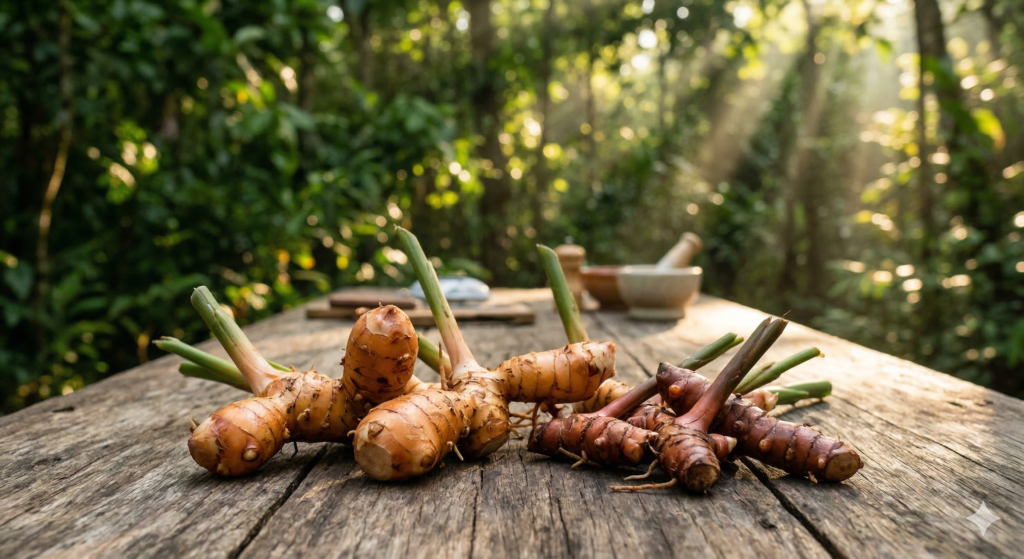
There is a root that smells like a forest after rain — pine, citrus, and pepper braided together with something warm and slightly medicinal. It sits unrecognised in the corner of Asian grocery stores, often mistaken for ginger. Its name is galangal. And its story is one of the most extraordinary botanical journeys in human history.
Alpinia galanga (greater galangal) and Alpinia officinarum (lesser galangal) are rhizomatous perennial plants in the Zingiberaceae family — cousins of ginger and turmeric, originating in the rainforests of Java and the coastal plains of southeastern China. What makes galangal extraordinary is its range: every major civilisation it encountered — Javanese, Chinese, Indian, Arab, Persian, medieval European — adopted it independently, documented it systematically, and integrated it into both cuisine and medicine as genuinely necessary.
Greater, Lesser, and the Others: The Galangal Family
Native to Java, Indonesia. Grows up to 2 metres. Flavour: floral, peppery, piney, with cinnamon notes. The dominant culinary galangal of Southeast Asia — essential in Thai, Indonesian, Malaysian, and Khmer cooking.
Native to southeastern China (Hainan Island). Smaller, reddish, more intensely medicinal. The galangal of TCM, Hildegard von Bingen, and medieval European pharmacy. Higher concentrations of galangin.
Often confused with true galangals. A distinct species with strongly camphorous flavour, used in Indonesian Jamu medicine. Different phytochemical profile — not interchangeable medicinally.
The word “galangal” derives from the Arabic khalanjan, itself an adaptation of the Chinese gao liang jiang meaning “high-quality ginger from Liang.” The linguistic trail maps the spice trade route.
The Global Journey of the Spice of Life
Greater galangal’s original centre of cultivation during the spice trade was Java. The Javanese name laos predates all other naming conventions. It was fermented with honey to produce traditional wines and ground into ceremonial pastes — food and medicine as an inseparable unity.
Lesser galangal is native to southeastern China. During the Tang Dynasty it was systematically integrated into TCM as Gao Liang Jiang — warming, acrid, entering the spleen and stomach meridians. Prescribed for cold abdominal pain, vomiting, and digestive stagnation. Also documented for asthma and chronic cough.
Known in Sanskrit as kulanja (Greater) and shati (Lesser), galangal was classified in Ayurveda as a warming, stimulating herb for digestion, respiratory conditions, rheumatism, and fever. Tamil Siddha medicine used it extensively. Unani prescribed it for cold catarrh, joint pain, urinary tract diseases, and neurological conditions including amnesia — the last application now confirmed by 2024 neuroprotection research.
Arab spice traders obtained lesser galangal from Chinese ports and carried it westward to Persia and the Levant. The first documented appearance in a European monastery spice account occurs at Corbie, France in the 9th century. By the end of the 10th century, the European spice trade dealt essentially with pepper, cinnamon, ginger, galangal, and clove — galangal among the five pillars of the medieval spice economy.
Hildegard von Bingen (1098–1179 CE) — Benedictine abbess, mystic, and one of the most comprehensive medical writers of the medieval period — called galangal “the spice of life” in her works Physica and Causae et Curae. She prescribed galangal wine for heart weakness and moderate fever; galangal powder in spring water for burning fever; galangal daily in soups and stews. Her recommendation for heart strengthening is now pharmacologically interesting: galangal’s anti-inflammatory and antioxidant profile directly addresses the oxidative stress underlying cardiovascular disease.
The 14th-century English cookbook The Forme of Cury — compiled for the court of Richard II — calls for galangal in multiple recipes. The French Le Viandier includes it in spiced sauces. In spiced wines known as hypocras, galangal was a standard ingredient. Russia developed its own tradition — a galangal vodka called Nastoika survives today.
“Every civilisation that acquired galangal — from Tang Dynasty China to medieval Germany — prescribed it for the same things: the stomach, the lungs, the heart, and the mind. Convergent independent observation across a thousand years is not tradition. It is evidence.”
What the Journals Actually Show
In a prospective, randomised, double-blinded human trial, galangal with pomegranate extract produced a 62% increase in total motile sperm count vs 20% in placebo after 90 days.
1′-Acetoxychavicol acetate (ACA) inhibits cancer cells via mitochondrial depolarisation and DNA fragmentation with activity documented across 8+ cancer types.
PAMPA permeability assays confirmed multiple galangal constituents demonstrate good passive diffusion across both the GI tract and blood-brain barrier, explaining traditional neurological applications.
Galangal extract ranked highest against antibiotic-resistant S. aureus among 67 spices tested. ACA at MIC 0.313 mg/mL damaged bacterial cell membrane integrity.
Anticancer Properties — The Most Intensively Studied Area
ACA induces apoptosis in cancer cells through mitochondrial depolarisation and DNA fragmentation. It has demonstrated cytotoxic effects across colorectal cancer, cervical cancer, leukaemia, pancreatic cancer, breast carcinoma, and hepatocellular carcinoma cell lines. A 2024 study confirmed ACA’s binding affinity to p53 tumour suppressor protein via molecular docking. ACA also shows inhibitory activity stronger than synthetic anti-allergic medications against antigen-induced generation of TNF-α, IL-4, and β-hexosaminidase.
Galangin (3,5,7-trihydroxyflavone) — the dominant flavonoid in lesser galangal — functions as a chemopreventive agent by reducing oxidative stress and inflammation through suppression of the MAPKs pathway. A study on gastric cancer cell line SGC-7901 found galangin reduced cell viability by 14.1–90.3% with stronger growth inhibition than quercetin at comparable concentrations.
Neuroprotective Effects — The Most Surprising Modern Validation
A 2024 review in Nutrients specifically examined lesser galangal’s neuroprotective potential in CNS disorders. It confirmed: reduction of oxidative stress and cell apoptosis in neural tissue; promotion of neurite outgrowth; modulation of neurotransmitter levels and signalling pathways. PAMPA membrane permeability analysis confirmed multiple galangal constituents demonstrate good passive diffusion across the blood-brain barrier. This explains why galangal was prescribed for amnesia and cognitive decline in Unani medicine over a millennium ago: it works, at least in part, because its active molecules can physically reach the brain.
Male Fertility — A Human Randomised Controlled Trial
A prospective, randomised, controlled, double-blinded trial (Fedder et al., 2014, PMC4190413) found that after 90 days of galangal rhizome powder with pomegranate extract, the average total number of motile sperm increased by 62% — from 23.4 million to 37.8 million — compared to 20% in placebo. The difference was statistically significant (p = 0.026).
Antimicrobial Against Drug-Resistant Bacteria
In a survey of 67 culinary spices for antibacterial activity against multidrug-resistant bacteria, galangal extract ranked highest against antibiotic-resistant Staphylococcus aureus. ACA damages bacterial cell membrane integrity at both MIC and MBC concentrations, inhibits proteins associated with cell wall synthesis, osmotic regulation, and bacterial adhesion — a multi-target mechanism that makes resistance development considerably more difficult than with single-target antibiotics.
Respiratory Health
The dominant volatile oil in galangal, 1,8-cineole (44.2–61.7% of essential oil), is a well-established bronchodilator and expectorant. This single compound explains traditional respiratory applications across Chinese, Ayurvedic, Unani, and Hildegardian medicine for asthma, chronic cough, catarrh, and sinus inflammation, including the traditional use as a snuff for nasal congestion.
What Makes Galangal Work
The signature pungent phenylpropanoid. Anticancer (mitochondrial depolarisation, DNA fragmentation), anti-HIV, antifungal, anti-allergic (stronger than ketotifen fumarate against IgE-mediated reactions), and the strongest antibacterial compound among 67 spices tested against MRSA.
The primary flavonoid, highest in lesser galangal. Antioxidant, anti-inflammatory (MAPKs suppression), anticancer, and an acetylcholinesterase inhibitor that preserves acetylcholine levels relevant to memory and cognitive function.
The dominant volatile oil (44–62% of essential oil). Potent bronchodilator and expectorant. Explains traditional respiratory applications across all medical systems. Also anti-inflammatory and CNS stimulant.
Flavonols with antioxidant, anti-inflammatory, and anticancer properties. Kaempferol is widely researched for its ability to induce apoptosis and inhibit angiogenesis in tumour biology.
Sesquiterpene hydrocarbons contributing to antimicrobial and anti-inflammatory activity. The ratio varies by geographic origin: Malaysian galangal is richer in β-farnesene; Indonesian galangal features more monoterpenoids.
Phenolic compounds with potent free radical scavenging activity. Aceteugenol shows an IC50 of 0.12 ± 0.03 μmol/L — among the most potent natural antioxidants documented.
Books That Carried Galangal’s Wisdom Across Time
The foundational Western medicinal texts on galangal. The origin of the phrase “the spice of life.” Prescriptions for galangal wine (heart and fever), galangal snuff (catarrh), and galangal in daily food.
The oldest surviving major English cookbook. Galangal appears in multiple recipes confirming its role in 14th-century European elite cooking.
Documents both lesser and greater galangal’s medicinal history, chemical constituents (volatile oil, resin, galangol, kaempferid, galangin, alpinin), and clinical uses as stimulant and carminative.
Award-winning history of the European spice trade in which galangal figures alongside pepper, ginger, and cinnamon as one of the five spices that drove medieval commerce.
Authoritative modern academic reference covering galangal’s pharmacological properties including anti-inflammatory, antioxidant, anticancer, cardiovascular, neuroprotective, antiviral, and antimicrobial activities.
The most comprehensive modern review of lesser galangal’s neuroprotective potential in CNS disorders including Alzheimer’s, Parkinson’s, depression, epilepsy, and cerebral ischaemia.
How to Use Galangal — From Kitchen to Medicine Cabinet
Galangal’s most powerful delivery system is the one it has always used: food. The civilisations that used it most effectively incorporated it daily into cooking, not occasionally as a supplement.
Add sliced or grated fresh galangal to soups, curries, stir-fries, and broths. Tom kha soup is the classical delivery vehicle — still one of the best.
Simmer 3–4 slices of fresh or dried galangal in water for 10 minutes with honey and lemon. Hildegard’s fever and digestive remedy. Effective for respiratory congestion, nausea, and bloating.
Simmer dried galangal slices in white wine for 15 minutes; cool and strain. The original medieval heart and digestive tonic with 800 years of documented use.
Ground galangal powder can be added to marinades, rice dishes, and spice blends. Use sparingly — more intensely flavoured than the fresh root.
A few drops of galangal essential oil or dried slices in hot water, inhaled as steam. The 1,8-cineole content makes this one of the most effective natural bronchodilator inhalations available.
Standardised galangal extracts are available in capsule form. For cognitive and anti-inflammatory applications, look for lesser galangal extracts standardised to galangin content.
Galangal has an excellent safety record at culinary and standard therapeutic doses. High-dose supplementation with ACA-rich preparations may theoretically enhance anticoagulant effects — consult a healthcare provider if you are on blood thinners. Not recommended in medicinal doses during pregnancy. Always verify the botanical name (Alpinia galanga or Alpinia officinarum) when purchasing, as “galangal” is sometimes misapplied to Kaempferia galanga (sand ginger), a different species with a different safety profile. These statements have not been evaluated by regulatory authorities. Galangal is not intended to diagnose, treat, cure, or prevent any disease.
Why Galangal Is the Perfect Argument Against Botanical Amnesia
In Europe, ginger replaced galangal not because it was superior, but because it was cheaper, more familiar, and more easily integrated into post-spice-trade European taste. The pharmacological properties that Hildegard documented, that the medieval physicians prescribed, that the Arab traders valued — none of it disappeared. It just stopped being remembered.
Meanwhile, in Indonesia, Thailand, Malaysia, and China, the memory never broke. Galangal never left the kitchen, never left the medicine cabinet, never stopped being both.
The 2024 Nutrients review on galangal’s neuroprotective effects is not discovering something new. It is rediscovering what Unani physicians prescribed for amnesia a thousand years ago. The 2021 antimicrobial study on ACA against drug-resistant Staphylococcus is confirming what every spice-trade-era cook knew intuitively.
Galangal does not need to be rebranded or repositioned. It needs only to be remembered.
The spice of life was never lost. We just stopped looking for it.
References & Sources (click to expand)
- Hildegard von Bingen (c. 1150–1179 CE). Physica and Causae et Curae. Latin medicinal texts.
- The Forme of Cury (c. 1390 CE). English royal cookbook compiled for Richard II.
- Grieve, M. (1931). A Modern Herbal. Jonathan Cape, London.
- Destryana, R.A. et al. (2024). The potential uses of Galangal (Alpinia sp.) essential oils. AIMS Agriculture and Food, 9(4):1064–1109.
- Abd Rahman, I.Z. et al. (2024). Potential Neuroprotective Effects of Alpinia officinarum. Nutrients, 16(19):3378. PMC11478918.
- Xing, L. et al. (2021). Discovery of ACA as promising antibacterial compound from galangal against MRSA. Industrial Crops and Products. ScienceDirect.
- Fedder, M.D. et al. (2014). Pomegranate and galangal rhizome increases motile sperm: randomised, double-blinded trial. PLOS ONE. PMC4190413.
- Abd Razak, M.F. et al. (2024). Phytochemical analysis, antioxidant, anticancer, and antibacterial potential of Alpinia galanga. Heliyon. PMC11403495.
- Turner, J. (2004). Spices: The History of a Temptation. Alfred A. Knopf.
- Amalraj, A. & Kuttappan, S. (2023). Chapter on Galangal. In Herbs, Spices and their Roles in Nutraceuticals and Functional Foods. Elsevier.