The Fern That
Fooled Medieval Europe
Cibotium barometz — the Vegetable Lamb, the golden hairs, and the pharmacology that outlasted the myth
For five hundred years, European scholars wrote seriously about a plant that grew a living lamb from its stem. The legend was wrong. The plant was real. And its golden woolly hairs — the feature that inspired the myth — turn out to be one of the most effective natural hemostatic agents documented across three separate pharmacopoeia traditions, validated long before modern science explained why.
The Vegetable Lamb of Tartary
“A most strange plant — or rather a living creature — a lamb born of the earth, connected by a stalk to the ground”
From the 13th century through the 17th, serious European naturalists — including John Mandeville and later Francis Bacon — described the Barometz or Scythian Lamb: a plant-animal hybrid in which a golden lamb grew from a plant stalk, ate the surrounding grass, and died when the vegetation was exhausted. This was not folklore. It appeared in formal botanical literature across multiple European countries for four centuries.
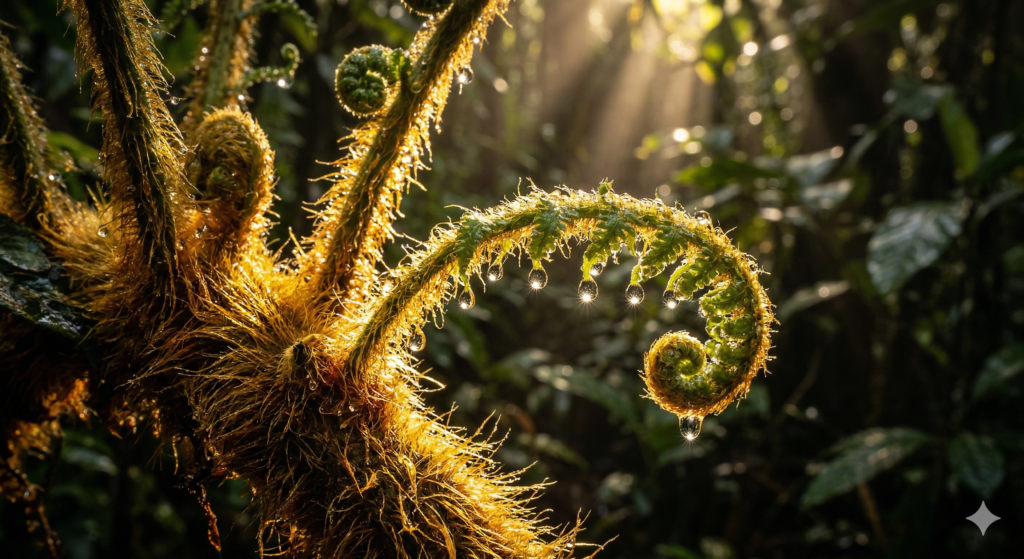
The source was almost certainly Cibotium barometz — brought along trade routes from Asia. The rhizome, covered in dense golden-brown woolly hairs and resembling a crouched animal when placed upside-down, was shown to merchants who had never seen anything like it. They named it after what they thought they saw.
The legend was wrong about what the plant was. Everything the traditional pharmacists knew about what it did was right.
Those same golden hairs — the source of the lamb myth — had been used across Malaysian, Chinese, and Indian traditional medicine for over a thousand years as a highly effective hemostatic agent. The Europeans invented a story. The Asians documented a medicine.
What the Evidence Shows
狗脊 (Gǒu Jǐ) listed since the Tang Dynasty. The kidney-bone connection documented before modern endocrinology had a framework for it.
Chinese, Ayurvedic, and Malaysian traditional medicine all independently documented the hemostatic golden hairs and back/joint applications — without contact with each other.
The Vegetable Lamb of Tartary was debated in formal European natural philosophy from the 13th to 18th century. The most elaborate myth ever attached to a medicinal plant.
Like Tongkat Ali, modern research has confirmed RANKL pathway inhibition — the same osteoclast mechanism targeted by pharmaceutical osteoporosis drugs including denosumab.
20-Hydroxyecdysone promotes osteoblast differentiation and suppresses osteoclasts — without androgenic activity. Bone protection through a pathway that avoids TRT risks entirely.
Two completely different traditional applications validated by two completely different modern mechanisms. The plant delivers both — from the same rhizome.
Five Things That Reframe Golden Fern
The feature that inspired 500 years of European myth — the golden hairs — is also the most pharmacologically validated traditional application.
Medieval Europeans saw the golden woolly hairs and invented a lamb. Asian practitioners used those same hairs to pack wounds for over a thousand years. The tannic acid content causes protein precipitation that seals bleeding surfaces — identical in mechanism to commercial hemostatic agents. Three traditions were right. Europe was fascinated by the wrong thing.
TCM classified it for “kidney” deficiency manifesting as lower back pain — 1,300 years before research confirmed its osteoblast-stimulating, osteoclast-inhibiting mechanism.
In TCM, kidney governs bones. A plant that tonifies kidney predicts bone protection. Modern research confirmed: RANKL inhibition, osteoblast promotion, bone mineral density preservation in animal models. Different conceptual framework. Same accurate clinical observation.
Ecdysteroids — the plant hormones in Golden Fern — protect bone without androgenic side effects. The bone protection pathway that avoids TRT risk entirely.
20-Hydroxyecdysone (20E) is the most studied phytoecdysteroid in human research. It promotes osteoblast activity and suppresses osteoclasts through mechanisms structurally independent of testosterone and estrogen. Relevant for anyone who needs bone protection without hormone supplementation.
Lower back pain and weak knees — the TCM indication — maps directly onto what modern medicine calls androgen-related bone and connective tissue deterioration.
The TCM kidney-yang deficiency pattern: lower back aching, weak knees, urinary frequency, cold extremities. Cibotium barometz addresses this from two independent angles — anti-inflammatory and bone-protective — both now confirmed at the compound level.
Malaysia is at the plant’s native range epicentre. The same fern that wound up in medieval European trade routes grows in Malaysian rainforests right now.
Native to Southeast Asian rainforests. The plant that inspired five centuries of European botanical fantasy is part of the same ecosystem that Orang Asli communities have used medicinally throughout. The story begins in Malaysia — not in a European natural philosophy text.
One Plant, Many Identities
“Golden Fern” — named for the unmistakable golden-brown woolly hairs. Traditional use for joint pain, back weakness, and wound healing.
“Golden-haired Dog’s Spine” — the full name explicitly referencing the golden hairs. Listed in Chinese Materia Medica since the Tang Dynasty for kidney-liver deficiency, lower back and knees.
The trade-route name that inspired the Vegetable Lamb myth. Likely derived from a Turkic word for lamb. The golden hairs and crouching rhizome form did the rest.
Family Cibotiaceae. “Barometz” is preserved directly from the medieval trade name — one of very few plants whose scientific name encodes a European myth.
Both reference the golden hairs. “Golden Chicken Fern” reflects Chinese folk naming — the crouching rhizome resembles a curled golden chicken to those who did not see a lamb.
Ayurvedic tradition documented the hemostatic and bone-supportive properties independently. The convergence with Chinese and Malay practice across three traditions is one of the strongest validations of this plant’s pharmacological reality.
What the Plant Contains
Cibotium barometz contains two distinct pharmacological systems: the rhizome’s structural compounds drive bone-protective and anti-inflammatory effects, while the golden crozier scales deliver the hemostatic mechanism. Traditional practice used both — and was correct about both.
Ecdysteroids (20-Hydroxyecdysone)
Plant hormones structurally related to insect moulting compounds. Documented anti-osteoporotic, anti-inflammatory, and anabolic effects without androgenic activity. Promotes osteoblast differentiation, suppresses osteoclasts — the same axis as pharmaceutical osteoporosis drugs, via a completely different pathway.
Tannic Acid (golden hairs)
The crozier scales are rich in tannic acid. Protein precipitation at wound surfaces seals bleeding through the same mechanism as commercial astringent hemostatic dressings. Pressing the golden hairs into wounds stops bleeding — the traditional application is pharmacologically precise.
Kaempferol & Caffeic Acid
Flavonoids with documented RANKL pathway inhibition. Kaempferol promotes osteoblast activity while suppressing osteoclast differentiation — directly validating the TCM kidney-bone classification through a mechanism the Tang Dynasty physicians could not have known.
Protocatechuic Acid
Inhibits NF-κB — the master inflammatory switch. Contributes to the documented reduction in joint inflammation. Works alongside the ecdysteroids to address both the bone structural and the inflammatory joint components of the TCM kidney-yang deficiency pattern.
Polyphenol Complex
Broad-spectrum antioxidant activity. Addresses oxidative stress upstream of both bone resorption and inflammatory joint disease — reducing the oxidative signalling that accelerates tissue degradation independently of the hormonal pathway.
Steroidal Saponins
Contribute to documented effects on urinary function and the kidney-yang pattern in TCM — cold extremities, urinary frequency, general vitality decline. The whole-plant preparation addresses this pattern more completely than any isolated compound.
Three Research Areas
When TCM’s Kidney-Bone Theory Meets Osteoblast Biology
Multiple studies evaluating Cibotium barometz in osteoporosis models find consistent results: bone mineral density preservation, improved trabecular microarchitecture, and biochemical markers of increased bone formation alongside decreased bone resorption.
Three independent bone-protective mechanisms identified: RANKL pathway inhibition (same molecular target as denosumab), kaempferol-mediated osteoblast promotion, and ecdysteroid-driven suppression of osteoclast differentiation. TCM classified this plant for “kidney deficiency manifesting in the bones” over a thousand years ago. The molecular biology arrived in the 21st century and confirmed what the clinical observation had already established.
Multiple animal model studies — Cibotium barometz, bone mineral density, RANKL inhibition, osteoblast/osteoclast regulation, trabecular structure.
Why Three Traditions Converged on the Same Application
The crozier scales of Cibotium barometz — the dense golden-brown woolly hairs — have been used to stop bleeding across Chinese, Malay, and Indian traditional medicine for over a millennium. The mechanism: high tannic acid content causes protein precipitation at the wound surface, sealing the bleeding area.
This is the same mechanism as modern astringent hemostatic agents. The golden hairs physically conform to wound surfaces, the tannic acid precipitates serum proteins, bleeding stops. Three separate medical traditions, with no contact with each other, all converged on the same application for the same compound doing the same thing. That level of cross-cultural convergence is not coincidence. It is systematic empirical observation producing accurate conclusions across three independent civilisations.
Tannic acid hemostatic mechanism. Cross-cultural convergence: Chinese Pharmacopoeia, Ayurvedic records, Malaysian ethnobotanical documentation.
The Bone Protection Pathway That Avoids the Hormonal Debate Entirely
20-Hydroxyecdysone (20E) promotes osteoblast differentiation and suppresses osteoclast activity through mechanisms structurally independent of testosterone and estrogen. The bone-protective effects do not require hormone supplementation and do not carry the cardiovascular and androgenic risks of TRT.
This matters for a specific patient population: postmenopausal women who cannot or will not use hormone replacement therapy, men with androgen decline who are not candidates for TRT, and anyone at risk of osteoporosis seeking non-hormonal bone support. The pharmaceutical options for this group are limited. A plant-derived non-hormonal bone-protective pathway with traditional documentation and modern mechanistic evidence is worth understanding.
20-Hydroxyecdysone: anabolic, anti-osteoporotic properties. Non-androgenic mechanism confirmed. Distinguished from testosterone and estrogen pathways in multiple studies.
The Golden Fern Malaysia Has — and Has Not Yet Fully Claimed
Cibotium barometz grows natively in Malaysian rainforests. It is used in traditional Malay medicine and by Orang Asli communities — primarily for joint pain, back weakness, and wound care. The golden hairs are part of Malaysian traditional wound knowledge that predates any European contact with the plant.
The plant was exported to Europe as a curiosity. It has been harvested for Chinese medicine export. What Malaysia has not yet done adequately is document and communicate its own traditional knowledge of the plant in a way that positions Malaysia as a primary knowledge-holder rather than a raw material supplier.
The wrong default: treating the Golden Fern as an export commodity. The plant that fooled medieval European scholars for five hundred years has a real story — and that story begins in Malaysian rainforests, not in a European natural philosophy text.
From Myth to Mechanism
First Chinese Pharmacopoeia Listing
狗脊 (Gǒu Jǐ) recorded in Chinese Materia Medica. Classification: warm, bitter-sweet; tonifies liver and kidney; strengthens lower back and knees; stops bleeding. The clinical framework that would guide use for 1,300 years is established.
Vegetable Lamb Enters European Literature
John Mandeville and European travellers describe the Barometz — a golden lamb growing from a plant. The golden rhizome of Cibotium barometz, carried along trade routes, becomes the source of one of medieval Europe’s most persistent botanical legends.
Francis Bacon Engages with the Legend
The Scythian Lamb is debated in formal European natural philosophy. The legend has persisted four centuries. Real specimens are arriving in European botanical collections — but the myth has momentum that outlasts early examinations.
Linnaeus Classifies the Species
Carl Linnaeus formally describes the species, preserving “barometz” from the medieval trade name in the scientific nomenclature. The myth ends officially. The name — and five centuries of confusion — becomes permanent in the botanical record.
Ecdysteroid Chemistry Characterised
20-Hydroxyecdysone and related ecdysteroids isolated and characterised. Research begins establishing bone-protective and anabolic mechanisms that explain 1,300 years of TCM clinical documentation. The kidney-bone connection starts yielding to molecular biology.
RANKL Inhibition and Bone Research Matures
Multiple studies document RANKL inhibition, osteoblast promotion, and bone mineral density preservation. Tannic acid hemostatic mechanism of the golden hairs characterised. The two traditional applications — bone support and wound healing — both confirmed at the molecular level.
Six Claims. Six Verdicts.
“The Vegetable Lamb legend meant the plant had no real medicinal value.”
The European legend was wrong about what the plant was. The Asian pharmacopoeia traditions — which had no interest in the legend — had been documenting accurate clinical applications for over a thousand years before European naturalists began debating the myth. Chinese Materia Medica listed bone-protective and hemostatic properties in the Tang Dynasty. The legend and the medicine existed in completely separate intellectual worlds. The legend was fantasy. The medicine was pharmacologically accurate.
“TCM’s kidney classification is metaphorical and has no pharmacological meaning.”
In TCM, kidney governs bones. A plant that tonifies kidney predicts bone protection. Modern research confirmed RANKL inhibition, osteoblast promotion, and bone mineral density preservation. The TCM kidney-bone framework was a clinical observation system, not a literal anatomical claim. It used different vocabulary to describe a relationship that molecular biology later confirmed. Different map. Same territory. Accurate destination.
“Using plant hairs to stop bleeding is primitive folk medicine with no basis.”
The golden hairs are rich in tannic acid, which causes protein precipitation at wound surfaces — sealing the bleeding area through the same mechanism as commercial astringent hemostatic agents. Three separate medical traditions independently converged on the same application for the same compound. Modern wound care uses tannic acid-based preparations for exactly this purpose. The so-called primitive application was correct. The biochemical explanation simply came later.
“Bone-protective herbs only work through hormones — no hormones means no bone benefit.”
Cibotium barometz’s primary bone-protective compounds — ecdysteroids and kaempferol — operate through non-hormonal mechanisms. 20-Hydroxyecdysone promotes osteoblasts and suppresses osteoclasts through pathways structurally independent of testosterone and estrogen. RANKL inhibition is also non-hormonal. This makes Golden Fern relevant for bone protection without hormone supplementation — a category with very limited pharmaceutical options currently available.
“Golden Fern is only for elderly people with osteoporosis.”
Bone loss begins in the thirties. Inflammatory joint disease affects adults of all ages. The hemostatic application of the golden hairs is age-neutral. The ecdysteroid anabolic properties have been studied in the context of athletic performance and muscle maintenance — young adult applications. The TCM kidney-yang deficiency pattern presents in younger adults under chronic stress, sleep deprivation, or overtraining. The plant is not an elderly-only herb. It addresses mechanisms relevant across the adult lifespan.
“This is a Chinese herb — it has nothing to do with Malaysian herbal tradition.”
Cibotium barometz is native to Malaysian and Southeast Asian rainforests. Malaysian traditional medicine (Paku Emas / Pakis Emas) and Orang Asli ethnobotanical records document the same applications as the Chinese Materia Medica — joint pain, back weakness, wound healing. The plant did not travel from China to Malaysia. It was in Malaysia before any trade route. The Chinese Pharmacopoeia documented what Malaysian practitioners had always known. The origin is Malaysian. The documentation reached farther.
How to Use Golden Fern
Cibotium barometz is used primarily as processed dried rhizome (狗脊, Gǒu Jǐ) for internal applications, and as the golden crozier scales (hairs) for topical hemostasis. Both applications have distinct preparation requirements.
Method: 6–12g processed dried rhizome in 3 cups water. Simmer 30–40 minutes, reduce to 1–1.5 cups. Strain and drink.
Dose: Twice daily during active treatment. Standard TCM preparation uses sand-fried or wine-processed rhizome to reduce potential irritants.
Important: Purchase processed (炮制) rhizome, not raw. The Chinese Pharmacopoeia monograph specifies the processed form.
Method: Press the dense golden-brown woolly fibres from the rhizome directly onto clean wound surfaces to stop surface bleeding.
Traditional use: Pack hairs directly onto the bleeding area with gentle pressure. Used across Malaysian, Chinese, and Indian traditional wound care.
Note: Topical use only. For minor surface wounds. Not a replacement for medical care in serious injuries.
Method: Commercial Cibotium barometz extract, ideally standardised to ecdysteroid content.
Look for: 20-Hydroxyecdysone percentage disclosed on label. Processed rhizome source specified. Third-party quality verification.
Note: Convenient but may not deliver the full synergistic matrix of the traditional whole-rhizome decoction.
Context: Rarely used alone in classical TCM. Most commonly combined with Eucommia bark (杜仲, Dù Zhòng) and Dipsacus root (续断, Xù Duàn) for the kidney-bone pattern.
Rationale: The formula approach addresses the full kidney-liver-bone presentation more completely than single-herb use. If working with a TCM practitioner, the formula context is appropriate.
Most bone research is animal-model: The RANKL inhibition, osteoblast promotion, and bone mineral density findings come from animal studies. Human clinical trials specifically targeting Cibotium barometz for bone density outcomes are not yet published at sufficient scale for definitive clinical claims.
Ecdysteroid research is promising but emerging: 20-Hydroxyecdysone is well-studied in animals and in human athletic performance contexts. Bone-specific human trial data is limited. The mechanism is confirmed; the clinical dose-response in humans needs further study.
Processing matters for safety: Raw rhizome may irritate the digestive system. The Chinese Pharmacopoeia specifies processed (sand-fried or wine-processed) material for internal use. Unprocessed material sold as Golden Fern supplement does not have the same safety and efficacy profile.
Pregnancy — use with caution: Traditional TCM classifications include specific contraindications in certain deficiency patterns. Not recommended during pregnancy without qualified TCM guidance.
Hemostatic use is topical only: The golden hairs address surface bleeding. Not indicated for internal bleeding or wounds requiring medical attention.
References & Sources ↓
- Chinese Pharmacopoeia — 狗脊 (Gǒu Jǐ) monograph. Cibotium barometz processed rhizome. Actions: tonify liver and kidney, strengthen lower back and knees, dispel wind-damp.
- Bone protection studies: RANKL inhibition, osteoblast promotion, bone mineral density preservation in animal models. Multiple published studies on Cibotium barometz extracts.
- 20-Hydroxyecdysone (20E): anti-osteoporotic and anabolic properties. Non-androgenic mechanism documented and distinguished from testosterone/estrogen pathways.
- Kaempferol: RANKL-induced osteoclastogenesis inhibition. Osteoblast promotion documented in multiple studies.
- Tannic acid hemostatic mechanism: protein precipitation at wound surfaces. Documented in crozier scales of Cibotium barometz. Cross-cultural convergence: Chinese Pharmacopoeia, Ayurvedic records, Malaysian ethnobotanical surveys.
- Protocatechuic acid: NF-κB anti-inflammatory pathway activity.
- The Vegetable Lamb of Tartary: Mandeville, J. (13th C). Travels. Bacon, F. (17th C). Natural History. Lee, H. (1887). The Vegetable Lamb of Tartary — historical scholarly analysis.
- Linnaeus, C. (1753). Species Plantarum. Formal classification of Cibotium barometz preserving the medieval trade name in scientific nomenclature.